



What is Latin America? In its narrowest and most common reading, it is the 20 sovereign countries of the Americas whose national language comes from Latin: 18 that use Spanish, plus Portuguese-speaking Brazil and French-speaking Haiti. That count is our own tally by the language rule, and it matches the 20-country list in the strict definition that Hispanic Outlook on Education published in 2021. The label is looser than it sounds. The United Nations draws a wider map with 52 countries and areas, and the language list leaves out places that sit on the same continent.
This guide puts the three definitions side by side, sorts out the words that get swapped for it, lists the countries, explains how South America and Latin America overlap and where the name comes from. It ends with what the label means when you are planning a trip. If your real question is where to go and what it costs, our guide to the cheapest South American countries to visit picks up where this one stops.
What is Latin America? Three definitions, three maps
Nobody owns the term, so three definitions circulate, and each gives a different count.
| Definition | Who uses it | What it includes | Count |
|---|---|---|---|
| Geoscheme | United Nations Statistics Division, as “Latin America and the Caribbean” | Mexico, Central America, South America and the whole Caribbean, including English, Dutch and French-speaking places | 52 countries and areas, 33 of them sovereign states by our count |
| Romance languages | Encyclopedias and most school atlases | Countries whose national language is Spanish, Portuguese or French | 20 sovereign states |
| Spanish-only | Usually called Hispanic America | The Spanish-speaking republics of the Americas | 18 sovereign states |
Britannica frames the region in the second way. Its history of Latin America covers South America, Mexico, Central America and the Romance-language-speaking Caribbean islands. The UN version is a statistical convenience, not a cultural claim: in the UN list the Caribbean has 28 entries, Central America has 8 (the UN places Mexico there, though on the map it sits in North America) and South America has 16. That puts Jamaica, Trinidad and Tobago and Guyana in the same region as Peru, which nobody means when they say “Latin America” in conversation.
For everyday use, the 20-country list is the answer. The UN list is the one to use when you read a statistic about “Latin America and the Caribbean” and want to know who was counted.
Latin America, Hispanic, Latino and Ibero-America: four words, four meanings
The terms get swapped, but they point at different things.
- Latin America is a place: the countries on the list below.
- Hispanic America is the Spanish-speaking part of that place, so it leaves out Brazil and Haiti.
- Ibero-America adds Spain and Portugal themselves to the Latin American countries.
- Hispanic or Latino is how the United States describes people. The U.S. Census Bureau treats it as an ethnicity, not a race, covering people of Cuban, Mexican, Puerto Rican, South or Central American or other Spanish culture or origin, whatever their race.
The last one describes people in the United States and does not map onto the country list. That is why a question about Latin America culture rarely has one answer: the region shares a language family and a colonial past, but not one culture.
South America & Antarctica: The First-Timer's Guide
Turn “someday” into a real itinerary: how five very different countries fit together, the multi country routes that actually work, and which border crossings cost you nothing and which cost you a full day.
Latin America countries: the list of 20
The map shows the three lists at once: the 20 countries on the language list, the South American places that are left off it, and the rest of the UN region.
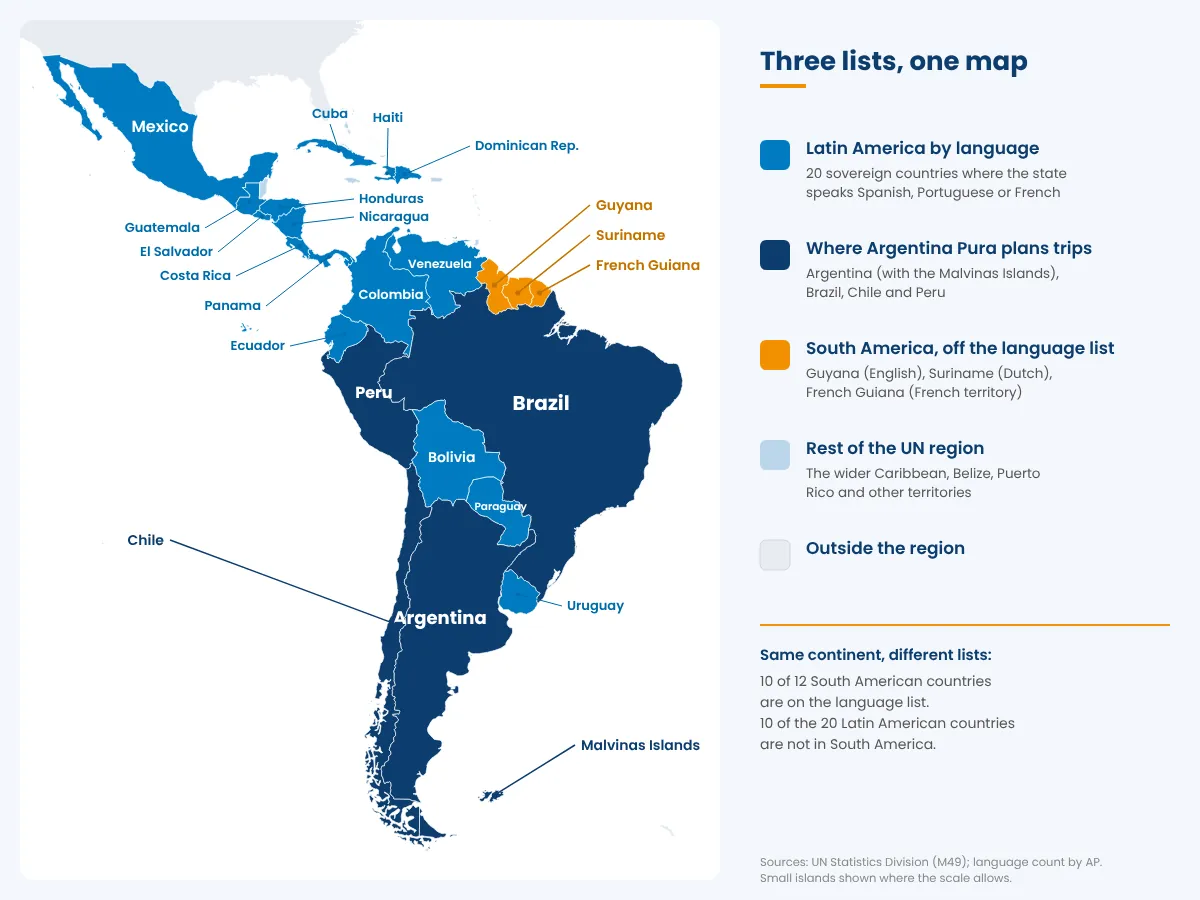
Sources: UN Statistics Division (M49) and our own language count. The Malvinas Islands are drawn with Argentina. Small islands are shown where the scale allows.
Grouped by region, the 20 look like this:
| Region | Countries | Count | Language of the state |
|---|---|---|---|
| Mexico | Mexico | 1 | Spanish |
| Central America | Costa Rica, El Salvador, Guatemala, Honduras, Nicaragua, Panama | 6 | Spanish |
| Caribbean | Cuba, Dominican Republic, Haiti | 3 | Spanish in Cuba and the Dominican Republic, French and Haitian Creole in Haiti |
| South America | Argentina, Bolivia, Brazil, Chile, Colombia, Ecuador, Paraguay, Peru, Uruguay, Venezuela | 10 | Spanish in nine, Portuguese in Brazil |
Haiti is the entry that moves most between lists, because its language is French and the Spanish-only definition drops it. Puerto Rico, a United States territory where Spanish is spoken, is often added to the list but is not a sovereign state, so it is not in the count of 20. Belize (English), Guyana (English) and Suriname (Dutch) are left out by the language rule, along with the French overseas territories such as French Guiana, Guadeloupe and Martinique.
Is South America Latin America? Only partly
South America and Latin America are two maps that overlap, and neither contains the other. The UN lists 12 sovereign states in South America. Ten of them are on the language list. The other two, Guyana and Suriname, are not, because their national languages are English and Dutch.
The overlap works in reverse too. Of the 20 Latin American countries, 10 are not in South America at all: Mexico, six in Central America and three in the Caribbean. So “South America vs Latin America” is not a question of one being bigger. The UN also lists four territories under South America: French Guiana, the Malvinas Islands (it writes “Falkland Islands (Malvinas)”), South Georgia and the South Sandwich Islands, and Bouvet Island. None of them is a sovereign country on the language list. Argentina claims sovereignty over the Malvinas, South Georgia and the South Sandwich Islands, so on our map the Malvinas are drawn with Argentina. The far southern end of the continent, where Cape Horn sits, is covered in our guide to the southernmost tip of South America.
Why is it called Latin America? The origin of the name
The long-held story says the name was a French invention, coined to justify Emperor Napoleon III’s intervention in Mexico in the 1860s. The historian Leslie Bethell, in a study published through the Wilson Center, argues the opposite: Spanish American writers in Paris used the term first, in the 1850s, as a way to claim a shared identity against the United States.
He names three early users. The Chilean Francisco Bilbao spoke of a “Latin American race” in Paris on 22 June 1856. The Panamanian Justo Arosemena used “América Latina” in Bogotá on 20 July 1856. The Colombian José María Torres Caicedo wrote the poem “Las dos Américas” in 1856, published in Paris in February 1857. The first known French use is later, by L. M. Tisserand in January 1861, which is why the French origin story does not hold up as the first word. One detail changes how you read the map: Bethell notes that neither the French nor the Spanish American writers included Brazil. Portuguese-speaking Brazil joined the label later.
What Latin America means for a trip: pick the country, and travel in your language
The label is a vocabulary word, not a destination. A trip is built from countries, and countries differ in entry rules, seasons, pace and the language of the state. Spanish is the language of the state in 18 of the 20, and Brazil and Haiti are the exceptions. The four countries where Argentina Pura plans trips show the range:
| Country | Language of the state | What to know |
|---|---|---|
| Argentina | Spanish | The language of public life. Guides and hosts work in other languages too, so your trip does not have to run in Spanish |
| Chile | Spanish | Same language, with its own vocabulary and accent |
| Brazil | Portuguese | The one large country on the list where Spanish is not the national language |
| Peru | Spanish | Under Article 48 of the Constitution, Quechua, Aymara and other native languages are also official where they predominate |
The table shows the language of the state, not the languages you will meet or the language of your trip. In every one of these countries, the services of a trip can be delivered in the language you need, and that is how we plan ours.
Peru is not unusual. Under Article 140 of its constitution, Paraguay’s official languages are Spanish and Guaraní. Bolivia’s constitution makes Spanish official together with the languages of its native peoples and names 36 of them in Article 5. “Spanish-speaking” is a fair summary of the region’s majority language and a poor description of any single country.
So choose by country, or by two neighbouring countries, not by the label. For a first trip to Argentina, our six decisions for a first trip puts them in order, and our guide to things to do in Argentina shows what each region is worth in days.
Latin America in one page
- The short answer. 20 sovereign states: 18 Spanish-speaking, plus Brazil and Haiti.
- The UN answer. 52 countries and areas, 33 of them sovereign, including the whole Caribbean.
- South America. It overlaps with Latin America in 10 countries. Guyana and Suriname are in South America and not on the language list.
- The name. Spanish American writers in Paris, in the 1850s, and without Brazil at first.
- For a trip. Pick a country, not the label. The language of the country does not set the language of your trip, because services can be delivered in yours.
If you already know which countries you are drawn to, tell us where you want to go and when, and we will tell you what fits.

Due to my professional background, I have extensive skills in the identification and characterization of target audiences, which allows me to understand the needs, preferences and specific behaviors of each segment, in order to design effective strategies that contribute to the success of the organization’s communication goals.
I work in the creation of digital content and the design of narratives for companies in the travel and tourism sector, contributing significantly to the promotion of destinations, services and exclusive experiences, generating a positive impact on brand perception.
Throughout my career, I have acquired solid experience in project planning and management, and I am passionate about research and data analysis, especially oriented to the development of user-centric products.
My experience encompasses the development and implementation of sustainable practices in processes, for building solutions that generate positive impact both socially and environmentally.
Always committed to designing effective solutions, I am dedicated to address challenges and contribute to the growth and development of teams and organizations with a holistic and sustainable approach.
0 Comment