



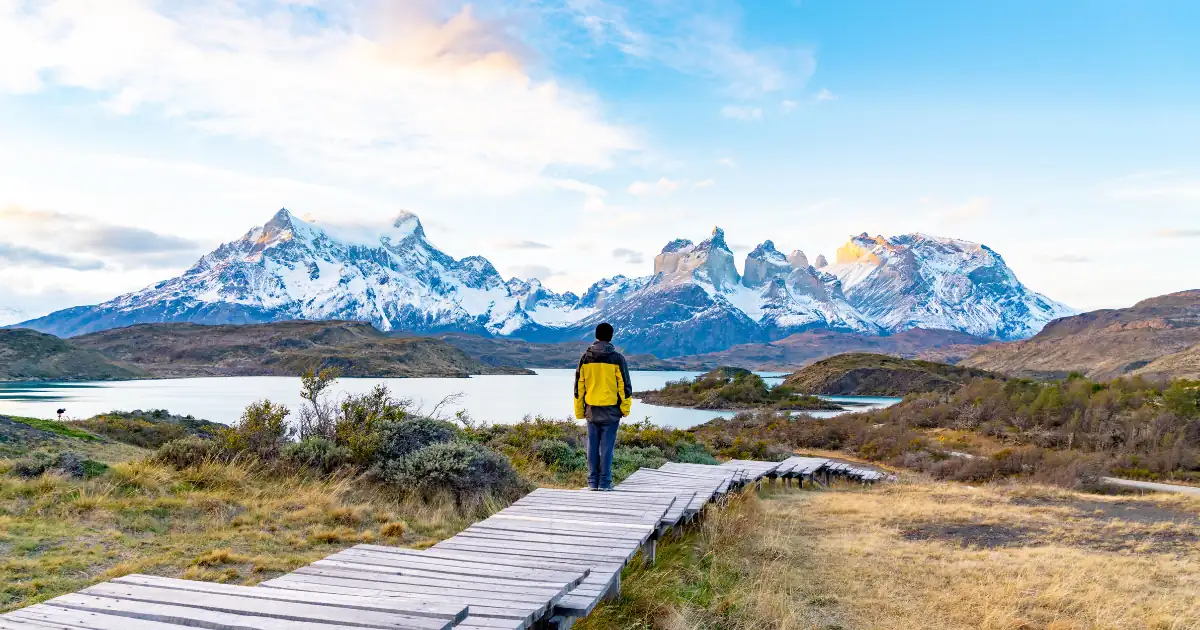
Torres del Paine is a national park in Chilean Patagonia, between 80 and 129 km by road from Puerto Natales depending on the entrance, built around granite peaks that glaciers shaped. What decides your plan is not the park itself but the road in: three entrances, three gateways, and in 2027 an airport that will not run on its normal schedule for three months.
This guide puts numbers on each choice: the distance to every entrance, the opening hours by season, how tickets work, and what the works at the Puerto Natales airport change between January and March 2027. If you are still choosing a month, start with our guide to the best time to visit Patagonia and come back here once you have a window.
What is Torres del Paine National Park?
Torres del Paine National Park is a protected area in the Magallanes region of Chile, managed by CONAF, the national forestry corporation. It was declared a UNESCO Biosphere Reserve in 1978 and holds seventeen ecosystems, according to CONAF’s official ticketing platform, consulted in October 2026. The landscape it is known for is the Paine massif, granite peaks shaped by glaciers, surrounded by lakes and subantarctic vegetation.
Three facts shape every visit:
- It is a park with rules, not an open landscape. Tickets are bought online in advance, and the park has its own hours that change with the season.
- There is no single trail. You can see viewpoints on day visits, walk the multi day W trek, or take on the longer Paine massif circuit, known as the O circuit. That circuit is closed until 31 October 2026, and CONAF says its reopening depends on weather and safety conditions at that time.
- The way in changes by year. Fees changed on 1 May 2026, and the nearest airport has works planned for early 2027. Both are covered below.
If trekking is the reason you are here, our guide to booking the W trek in Torres del Paine explains how the beds decide your route.
Where is Torres del Paine? Three gateways and three entrances
Puerto Natales is the town closest to Torres del Paine, and almost every trip starts there. The park tourism information site, torresdelpaine.com, gives the road distance from Puerto Natales to each entrance:
| Entrance | Road distance from Puerto Natales |
|---|---|
| Serrano | 80 km |
| Sarmiento | 112 km |
| Laguna Amarga | 129 km |
Chile’s national tourism service (Sernatur) puts the bus ride from Puerto Natales to Laguna Amarga, the first stop inside the park, at about two hours.
The Patagonia First-Timer's Guide
Download the practical side of Patagonia in one guide: real driving times between bases, how park tickets and discounts work, what you can't take across into Chile, and a worksheet to get a sharper quote.
You reach Puerto Natales by one of three doors, and the one you pick sets the first day of your trip.
| Gateway | How you arrive | To Puerto Natales |
|---|---|---|
| Puerto Natales airport | Flight from Santiago, 3 hours 17 minutes and about 2,000 km, according to Sernatur | A taxi from the airport to the bus station takes about 11 minutes |
| Punta Arenas airport | Flight from Santiago, 3 hours 27 minutes | 254 km by bus or car, just over 3 hours |
| El Calafate, Argentina | Domestic flight in Argentina | About 270 km by road, 5.5 to 6 hours with the border crossing at Cerro Castillo (our own operations data) |
The first two stay inside Chile. The third crosses from Argentina into Chile, which is why El Calafate and Puerto Natales work as a pair even though they are only about 155 km apart in a straight line. Our guide to where Patagonia is shows that pair on a map with the distances to the other bases. For passports, currency and the rest of what changes at the line, see which country each base is in.
Puerto Natales airport in 2027: what the works change
In a communiqué dated 14 August 2026, Chile’s Ministry of Public Works (MOP) confirmed conservation work on the runway of the Teniente Julio Gallardo aerodrome in Puerto Natales, to be done in shifts between January and March 2027. A full closure from mid February was proposed and rejected, because it would have left fewer flights. The plan the MOP adopted keeps the airport open on some days:
| Month in 2027 | Days the airport is open | Share of passenger and cargo flights kept |
|---|---|---|
| January | Friday to Sunday | 67 percent |
| February | Weekends only | 41 percent |
| March | Weekends only | 32 percent |
The runway is shortened in phases. In the first ten days of January it keeps 1,600 to 2,000 m, enough for A320neo jets. After that it drops to 1,200 m, which suits regional jets carrying 85 to 100 passengers, and that phase runs until 2 February. The MOP says emergency flights, medical evacuations and the Antarctic air link will keep operating.
What this means for a trip between January and March 2027:
- Check the weekday of your flight first. A flight into Puerto Natales on a Tuesday in February is not part of the plan the MOP described.
- Punta Arenas is the fallback. It adds just over 3 hours of bus to your first day, but it does not depend on the works.
- The works meet the main season. January and February fall in the November to March season when operators run everything, so the same demand lands on fewer flights.
Ask the airline about your exact date, because schedules can change after a communiqué like this one. Our team confirms the current options for your dates.
How many days do you need in Torres del Paine?
Start with the road. From Puerto Natales, Laguna Amarga is 129 km each way, so a day visit is about 258 km and roughly four hours in a vehicle, using Sernatur’s two hour estimate for each direction. From October to April the park is open from 07:00 to 21:00, and from May to September from 08:00 to 18:30, according to the CONAF ticketing platform.
That arithmetic gives three honest ways to use the park:
| Plan | What it gives you | Where you sleep |
|---|---|---|
| Day visit from Puerto Natales | The viewpoints and short walks, with about four hours of the day spent on the road | Puerto Natales |
| A few nights near the park | Time for one full walking day without the return drive | Inside or beside the park |
| W trek or O circuit | Multi day trekking, with beds reserved before you enter the mountain area | Refugios, domes or tents |
Our recommendation is to sleep at least two nights near the park if the trip allows it. The reason is the road, not the scenery: the first and last days stop being bus days. If you want to trek, count nights rather than days, because the reservation of each bed fixes the route.
Where to stay: Puerto Natales or inside Torres del Paine?
Puerto Natales has the airport, the bus station and the choice of restaurants and rooms, but every park day starts with two hours on the road. Inside the park you trade services for time. Our guides to the hotels and lodges in Torres del Paine and to Ecocamp Patagonia show what is available, and the entrance table above shows how much road each side saves you: Serrano is 80 km from Puerto Natales, against 129 km to Laguna Amarga.
If the park is one stop in a longer trip, our Patagonia itinerary guide shows how many days each base deserves, and the Patagonia trip cost guide explains what moves the price.
Hiking in Torres del Paine: day walks, the W trek and the O circuit
How hard the hiking is depends on the route you choose, not on the park. Short walks to viewpoints are day outings. The W trek and the O circuit are multi day routes, and they have their own booking rule: according to the park’s reservations page, consulted in October 2026, hikers on the W trek and the Paine massif circuit must reserve accommodation in advance, and without those reservations they cannot enter the mountain area. The rule does not apply to day hikes such as Base Torres.
CONAF says it will not introduce access regulation for the Base Torres trail in 2026, although it keeps evaluating one. For winter conditions or high difficulty routes it requires a guide authorized by CONAF or by the competent authority, and its ticketing platform says the use of microspikes and trekking poles remains recommended and required for safety.
For the routes themselves, we go deeper in our guides to the W trek, the O circuit and Refugio Grey.
Torres del Paine tickets, hours and rules
Since 1 May 2026, CONAF has sold park entry under a new system: a single day ticket, and a ticket for two or more days that is valid for up to ten continuous days. Tickets are sold online on CONAF’s platform, pasesparques.cl, and visitors who book trips with buses, boat trips or excursions must buy theirs there too. After payment you receive a QR code to show at the gate, so save it on your phone before you leave Puerto Natales.
| Season | Months | Hours | Last entry |
|---|---|---|---|
| Summer | October to April | 07:00 to 21:00 | 21:00 |
| Winter | May to September | 08:00 to 18:30 | 18:30 |
CONAF notes that hours and days can change with the weather or for safety reasons. National and foreign tickets are bought in separate steps and added to the same basket before payment.
The park publishes its 2026 fee table for foreign visitors in Chilean pesos on its official website. We converted the adult rates to US dollars at the Central Bank of Chile’s observed dollar of 979.85 pesos on 8 October 2026.
| Foreign visitor | Day ticket | Two or more days |
|---|---|---|
| Adult, 18 and over | 32,400 pesos, about US$33 | 48,500 pesos, about US$49 |
| Child under 12 | Free | Free |
A ticket for two or more days costs about 50 percent more than a day ticket, so each extra day adds roughly US$16 instead of another US$33. Rates for teenagers are lower and are shown at checkout. Treat the dollar figures as a reference for that date, because the peso moves and the amount charged is the one on the checkout page. Sources disagree on the day rate for adults, with one tourism site listing 34,000 pesos, so check the total before you pay. It is also the number to compare against tour prices, because a tour that includes the entry should say so.
When to visit Torres del Paine
The ticketing platform lists hours for both seasons, so the park can be visited all year, but the season sets the hours and the rules. The summer hours above run from October to April, and the winter regulation on guides applies from 1 May. Wind, sun and snow by month are in our guide to the best time to visit Patagonia, built from Argentina’s national weather service records.
Planning Torres del Paine in one page
- Pick the gateway. Puerto Natales airport, Punta Arenas or El Calafate, and check the 2027 airport schedule if you travel between January and March.
- Pick the entrance. Serrano at 80 km, Sarmiento at 112 km or Laguna Amarga at 129 km from Puerto Natales.
- Pick the format. A day visit costs about four hours on the road, and a trek needs nights reserved before you enter the mountain area.
- Buy the ticket online. CONAF sells it on pasesparques.cl, at about US$33 for a foreign adult day ticket or about US$49 for two or more days.
If you already have dates, tell us when you travel and who is coming, and we will check which gateway and which days fit.

Due to my professional background, I have extensive skills in the identification and characterization of target audiences, which allows me to understand the needs, preferences and specific behaviors of each segment, in order to design effective strategies that contribute to the success of the organization’s communication goals.
I work in the creation of digital content and the design of narratives for companies in the travel and tourism sector, contributing significantly to the promotion of destinations, services and exclusive experiences, generating a positive impact on brand perception.
Throughout my career, I have acquired solid experience in project planning and management, and I am passionate about research and data analysis, especially oriented to the development of user-centric products.
My experience encompasses the development and implementation of sustainable practices in processes, for building solutions that generate positive impact both socially and environmentally.
Always committed to designing effective solutions, I am dedicated to address challenges and contribute to the growth and development of teams and organizations with a holistic and sustainable approach.

0 Comment