



# Bariloche Argentina: where it sits, how to reach it and how many days it needs
Bariloche Argentina is a lake city in the Andes, 1,640 to 1,680 km by road from Buenos Aires, according to the city’s official tourism board, consulted in October 2026 (the board prints both figures, on different pages). That distance is the first planning fact. Few travellers drive to Bariloche from the capital, so the journey usually starts with a flight, and everything after it is measured in tens of kilometres, not hundreds.
This guide covers what Bariloche is, how far it is from everything else, how to arrive, the trips from town that fill the days and how many days they add up to. If you are still choosing a month, start with our guide to the best time to visit Patagonia and come back once you have a window. Where Bariloche sits on the wider map is in our guide to where Patagonia is.
What is Bariloche, Argentina? A city inside a national park
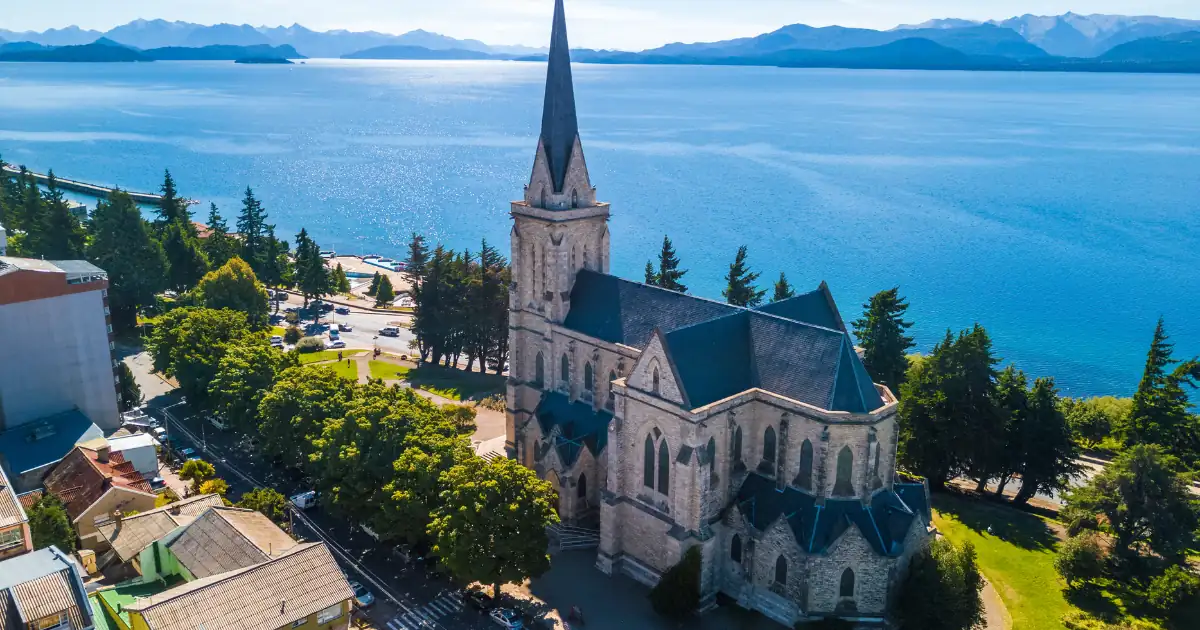
San Carlos de Bariloche is in Río Negro province, on the shore of Lake Nahuel Huapi, and its municipal area lies inside Nahuel Huapi National Park. The park covers 717,261 hectares, according to its administration, which traces the park’s origin to 1903, when the explorer Francisco Moreno donated land to the Argentine state. Congress made it a national park by law in 1934. The tourism board adds two titles the city holds: Argentine Capital of Adventure Tourism since 2012 and Argentine Capital of Chocolate since 2015.
For planning, that means the city is the base and the park is the destination. Cerro Tronador, 3,478 m high with glaciers on its summit, is one of the most visited places in the park, according to the park administration. The same source sets the rules that shape a day out: trekking registration before any hike is mandatory and free, and lakes and rivers run at about 5 to 12 °C, so the water is for looking at, not for swimming. If beach days matter, our guide to Argentina beaches sorts the Atlantic coasts by distance from Buenos Aires.
How far is Bariloche from everything else?
The tourism board lists road distances to Bariloche from nine places:
| Origin | Road distance to Bariloche |
|---|---|
| Villa La Angostura | 83 km |
| El Bolsón | 131 km |
| Esquel | 300 km |
| Neuquén | 416 km |
| Mendoza | 1,221 km |
| Córdoba | 1,610 km |
| Buenos Aires | 1,640 km |
| Ushuaia | 2,228 km |
| Salta | 2,449 km |
Read it as two groups. Only Villa La Angostura and El Bolsón are close enough to treat as part of a Bariloche stay, and the nearest large city, Neuquén, is already 416 km away. From Mendoza onward the distances are long enough that most travellers fly, which is why the next section starts at the airport.
Southern Argentina: The First-Timer's Guide
Get your southern Argentina route right from the start: what El Calafate, El Chaltén, Ushuaia, Bariloche and Puerto Madryn each offer, who each one suits, how they compare on climate and effort, and the mistakes first trips make combining them.
How to get to Bariloche Argentina: air, bus, rail and the Chile side
By air you land at Teniente Luis Candelaria International Airport, on Provincial Route 80, according to the Río Negro government. The tourism board names four airlines that serve Bariloche: Aerolíneas Argentinas, JetSMART, Flybondi and LADE. The board also lists seasonal direct flights from Santiago, with LATAM flying Friday, Saturday and Sunday from December 6 to March 23 and SKY flying Tuesday, Thursday, Saturday and Sunday from November 28 to March 30. Those dates are for the 2024 and 2025 summer, which is what the page still shows, so treat them as the pattern and check the current schedule before you plan around a direct flight.
From the airport, the city’s bus line 72 links downtown, the bus station and the airport, and public buses take only a SUBE card, which you buy at a kiosk or at the SUBE office in the Civic Center, according to the board.
By bus, the board lists companies such as Andesmar, Chevallier, Don Otto and Via Bariloche, with seat classes from basic to full bed. The board gives no travel time from Buenos Aires, so we do not print one. The unusual option is the Patagonic Train, which runs weekly between Viedma and Bariloche, leaving Viedma on Fridays and arriving on Saturdays.
Inside the city, line 20 runs from the bus terminal through downtown to Llao Llao and line 10 goes to Colonia Suiza. Taxis are white and light blue. For the rest, you need either a tour or a car, which the next section’s distances explain.
Day trips from Bariloche: the distances that set your days
Here are the five trips that fill most visits, with the figures from the tourism board’s pages:
| Trip | Distance from downtown | Time, according to the board | Detail |
|---|---|---|---|
| Lago Gutiérrez | 16 km | Not listed | Drive from the centre |
| Cerro Campanario | 17 km | 1 to 2 hours on site, 4 hours counting transport | Chairlift about 7 minutes, or a 30 minute climb on foot |
| Colonia Suiza | 24 km | Not listed | Detour to the left at kilometre 42 of the Circuito Chico |
| Circuito Chico | About 60 km loop | 3.5 to 4 hours with an authorised agency, all day on your own | Asphalt road, open all year |
| Seven Lakes road to San Martín de los Andes | 190 km one way | Not listed | Via Villa La Angostura, 83 km, then 107 km |
The table hides one useful fact. The Circuito Chico already contains Cerro Campanario, the Llao Llao area and a panoramic viewpoint at 945 m above sea level, according to the board, so these are not separate days. Colonia Suiza is a detour from the same loop, which in our reading lets a day on your own cover both. The Seven Lakes road is the opposite case. The board gives 83 km to Villa La Angostura and 107 km from there to San Martín de los Andes, which adds up to the 190 km on its distance list, so a return trip is about 380 km and takes a full day, or one direction with a night in San Martín. Our guide to the Seven Lakes route covers the road stop by stop.
How many days do you need in Bariloche?
Count the days as pieces, using the distances above:
| Piece | Days |
|---|---|
| Arrival and town | Half a day |
| Circuito Chico, with Cerro Campanario | 1 |
| Seven Lakes road, round trip | 1 |
| A park day: a lake or a registered trek | 1 |
| Margin day for weather | 1 |
Those pieces add up to four and a half days. Three nights is the floor, which drops the park day and the margin. Five nights is comfortable and keeps a spare day for wind or rain. These day counts are our own recommendation, built from the board’s distances, and they are not an official figure. In winter the arithmetic changes, because Cerro Catedral takes the days that the park takes in summer, and the board describes its skiable terrain as 1,200 hectares.
For a day by day route that links Bariloche with other bases, our Patagonia itinerary guide shows how the days fit together, and our guide to the Lake District on both sides of the border covers the wider region.
Bariloche in summer and in winter
The tourism board defines summer as December 21 to March 20, with temperatures up to about 30 °C, sunrise at 6:15 and sunset at 9:20 in the evening. Winter runs from June 21 to September 20, with snow and temperatures between 0 °C and minus 10 °C. The board is not consistent on the ski season itself. One page says June to September and another says July to October, so the real opening depends on the snow. For wind, sun and snow month by month, use the best time to visit Patagonia guide.
Crossing from Bariloche to Chile
Bariloche is the main starting point for the Chile side of the Lake District. Drivers take Route 40 to Villa La Angostura, 83 km, and then 53 km more to the Cardenal Samoré crossing. That puts the border 136 km from Bariloche. The board says the crossing is paved and open all year, snow chains are required in winter, and its page lists hours of 9:00 to 19:00 in winter and 8:00 to 19:00 in summer. Border hours change, so confirm them before you leave.
Beyond the border, the board gives these road distances from Bariloche: Osorno 250 km, Frutillar 300 km, Puerto Varas 318 km, Valdivia 348 km and Puerto Montt 390 km. The alternative is the Pérez Rosales route by lake and bus through Puerto Frías to Peulla, which the board says takes one day in summer and two in winter, with a night in Peulla. What waits on the Chile side is in our guide to Patagonia Chile, and the paperwork and the clock change are in our guide on whether Patagonia is a country.
Planning Bariloche Argentina in one page
- Fly in. The road from Buenos Aires is 1,640 km or more, so most travellers fly. Plan arrival as half a day.
- Count the nights. Three is the floor, five is comfortable.
- Treat the Circuito Chico as one day. It already includes Cerro Campanario and Llao Llao.
- Give the Seven Lakes a full day. It is 190 km one way to San Martín de los Andes.
- Register before you trek. The park requires it, and it is free.
- Check the border. The Cardenal Samoré crossing is 136 km from the city, and its hours change.
If you already have dates, tell us when you travel and who is coming, and we will check which days fit.

Due to my professional background, I have extensive skills in the identification and characterization of target audiences, which allows me to understand the needs, preferences and specific behaviors of each segment, in order to design effective strategies that contribute to the success of the organization’s communication goals.
I work in the creation of digital content and the design of narratives for companies in the travel and tourism sector, contributing significantly to the promotion of destinations, services and exclusive experiences, generating a positive impact on brand perception.
Throughout my career, I have acquired solid experience in project planning and management, and I am passionate about research and data analysis, especially oriented to the development of user-centric products.
My experience encompasses the development and implementation of sustainable practices in processes, for building solutions that generate positive impact both socially and environmentally.
Always committed to designing effective solutions, I am dedicated to address challenges and contribute to the growth and development of teams and organizations with a holistic and sustainable approach.
0 Comment