



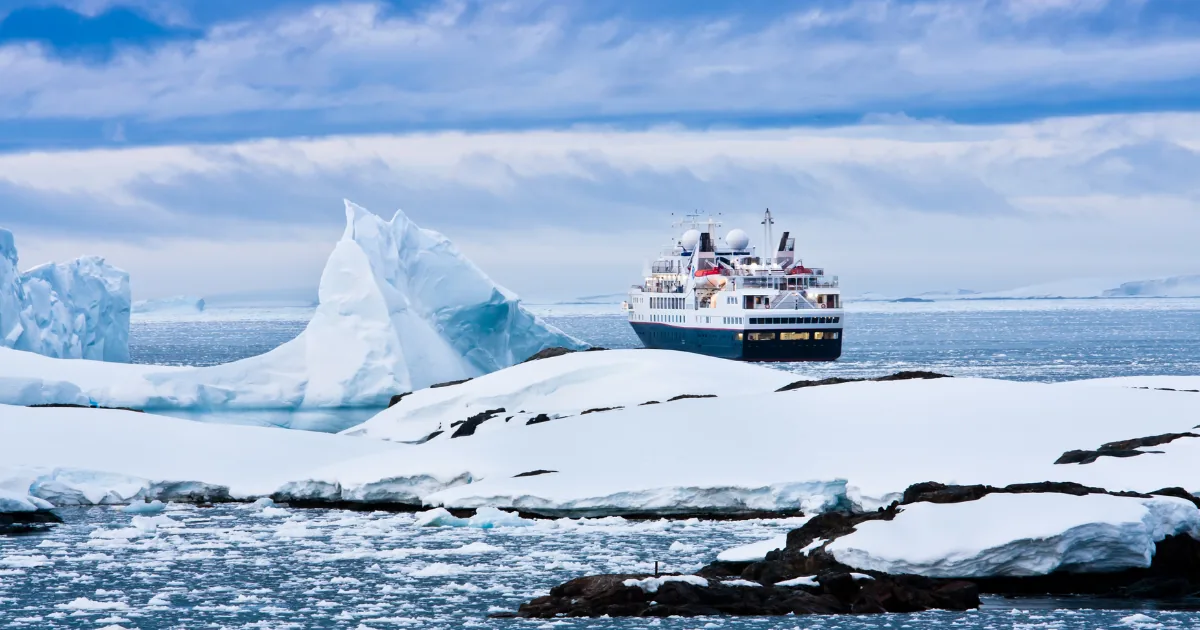
Antarctica weather in the cruise season is colder than most people plan for and milder than most people fear. On the South Shetland Islands and the tip of the Antarctic Peninsula, where expedition ships actually go, the average high from November to March sits just above freezing, between 35 and 40 °F (about 2 to 4 °C). The part that surprises travellers is not the cold. It is how little direct sun reaches you on a summer day, and how the weather decides what you can do on each landing.
This guide uses the long-term records of two Argentine research stations on the cruise route, not a weather widget, and turns them into a month by month picture of what to pack for and what to expect. If you are weighing dates for a trip, our Patagonia and Antarctica itinerary shows how the weather windows fit around the days you spend before and after the ship.
Antarctica weather by month on the cruise route
The figures below come from Argentina’s national weather service (Servicio Meteorológico Nacional, SMN) and its published climate normals for 1991 to 2020. We use two stations because they bracket the places ships visit. Base Carlini, at 62.2 degrees south, represents the South Shetland Islands. Base Esperanza, at 63.4 degrees south, sits at the northern tip of the Peninsula. Tourist ships operate from November to March, according to the International Association of Antarctica Tour Operators (IAATO), so those are the months shown.
| Month | Carlini average high | Carlini average low | Esperanza average high | Esperanza average low | Daylight |
|---|---|---|---|---|---|
| November | 35 °F (1.7 °C) | 28 °F (minus 2.2 °C) | 36 °F (2.3 °C) | 25 °F (minus 3.9 °C) | about 17 hours |
| December | 38 °F (3.2 °C) | 31 °F (minus 0.6 °C) | 39 °F (3.8 °C) | 29 °F (minus 1.8 °C) | about 19 hours |
| January | 40 °F (4.3 °C) | 33 °F (0.4 °C) | 40 °F (4.3 °C) | 30 °F (minus 1.2 °C) | about 18 hours |
| February | 39 °F (3.9 °C) | 32 °F (0.2 °C) | 39 °F (3.9 °C) | 28 °F (minus 2.0 °C) | about 15 hours |
| March | 37 °F (2.9 °C) | 30 °F (minus 1.2 °C) | 35 °F (1.4 °C) | 23 °F (minus 5.2 °C) | about 12.5 hours |
The daylight column is our own calculation of sunrise to sunset at about 62 degrees south in the middle of each month, not an SMN figure. At Esperanza the days run up to half an hour longer than at Carlini.
South America & Antarctica: The Season Planner
Pick the right month before you pick the route: one printable chart with weather, crowds, wildlife windows and what's open in Patagonia, the Atacama, Peru, Iguazú Falls and Antarctica, month by month.
Two things stand out. January is the warmest month at both stations by average temperature, and December has the longest day. And the drop in March is real: Esperanza’s average low falls to 23 °F (minus 5.2 °C) while the day shrinks to about twelve and a half hours, which is why ships stop sailing soon after.
Antarctica temperature: how cold it is where ships actually go
The coldest numbers people quote for Antarctica belong to the interior, not the coast. The same SMN tables include Base Belgrano II, deep in the continent at 77.9 degrees south, where the annual average temperature is 8 °F (minus 13.2 °C). At Carlini it is 29 °F (minus 1.7 °C) and at Esperanza 24 °F (minus 4.5 °C).
In January the gap is even clearer. Belgrano II averages 27 °F (minus 2.6 °C) for the whole month, while Carlini averages 36 °F (2.2 °C). So the Antarctica climate splits in two: a bitter interior and a coast where summer air hovers near freezing, which is the temperature you will dress for on deck.
Winter is a different place. In July the average falls to 22 °F (minus 5.8 °C) at Carlini and 13 °F (minus 10.8 °C) at Esperanza, and by our calculation only about four hours of daylight at midwinter. That is the practical reason no cruise sails then.
Is Antarctica sunny in summer? What the station records show
This is the part most weather pages skip. Daylight is long, but direct sunshine is short. The stations measure the hours of effective sunshine, meaning the hours the sun actually breaks through and casts a shadow.
| Month | Direct sun per day at Carlini | Direct sun per day at Esperanza | Days with snow at Carlini | Days with snow at Esperanza |
|---|---|---|---|---|
| November | 2.8 hours | 5.3 hours | 15.6 | 15.5 |
| December | 3.0 hours | 6.0 hours | 12.9 | 14.1 |
| January | 2.7 hours | 5.4 hours | 10.1 | 13.6 |
| February | 2.3 hours | 4.6 hours | 8.4 | 12.1 |
| March | 1.7 hours | 3.0 hours | 12.3 | 14.8 |
In January Carlini gets about 2.7 hours of direct sun out of roughly 18 hours of daylight, about one hour in seven. Esperanza, about 150 kilometres away and further south, gets 5.4 hours, closer to one hour in three. Cloud cover tells the same story: in January the sky averages 7.1 eighths covered at Carlini and 6.3 at Esperanza. The South Shetlands are the greyer side of the route, and the tip of the Peninsula is brighter.
Snow is frequent in every month of the season. Carlini records snow on 10 days in January, Esperanza on almost 14. Plan for a waterproof outer layer on any day, not just on the days the forecast looks bad.
One caution. These are readings at a station on land. At sea and on a landing beach the wind and spray change how the same temperature feels. The SMN tables for these two bases leave wind speed and rainfall blank for 1991 to 2020, so we do not quote averages for them.
Weather in Antarctica month by month: what changes on the trip
Weather and wildlife move together, so the month you choose shapes what you see as much as what you wear.
November
The season opens with snow at its most frequent, about 15 days with snow in the month at both stations. Penguins return to their colonies in late October and early November to settle and build nests, according to Aurora Expeditions. Days reach about 17 hours.
December
The longest days of the year, about 19 hours, and monthly averages above freezing at both stations. Chicks begin to hatch from December into January, so colonies are busy with feeding parents.
January
The warmest month by average temperature at both stations, with highs of 40 °F (4.3 °C) and an average low above freezing at Carlini.
February
Highs stay near 39 °F (3.9 °C) at both stations while the day shortens to about 15 hours. Penguins start to moult in February and March. Whales that migrate south to feed on krill through the warmer months are part of the picture too, and the exact sightings vary from one season to the next.
March
Colder and darker. Esperanza’s average low reaches 23 °F (minus 5.2 °C) and the day is down to about 12.5 hours, which is where the cruise season ends.
The Drake Passage and the wind
The weather you meet on a ship starts before the Peninsula. Crossing the Drake Passage takes around 48 hours each way, according to Patagonline, a Patagonia travel guide, and a rough crossing can bring swells of up to 15 metres. A calm crossing exists, but it is the less common one, and nobody can promise which one you will get.
If you would rather not spend four days of a trip on the crossing, some routes fly across the Drake instead of sailing it, such as our Antarctic Express, Fly the Drake, which runs 8 days. For a full sailing route, compare the 11-Day Antarctic Explorer. Both are part of our Antarctica cruises.
How the weather shapes landings
Weather is only one of the limits on what you do ashore. IAATO guidelines do not allow landings from ships carrying more than 500 passengers, cap the number of visitors ashore at 100 at any one time, require one guide for every 20 visitors, and allow only one ship at a site at a time. Wind, swell and ice then decide which sites a captain and expedition leader can use on a given day.
That is why a good itinerary has slack, and why only ships under 500 passengers land at all. If you are comparing departures, ask each operator how many landings per voyage they plan and how they handle a day when the weather closes a site.
What to wear for Antarctica weather
Dress in layers you can add and remove on deck. A warm base layer, an insulating middle layer and a waterproof, windproof outer shell cover almost every day of the season. Gloves that stay usable when wet, a hat, and sunglasses for glare off snow and water matter as much as the jacket. Ask your operator what is supplied on board and what you need to bring.
Choosing a month by what matters to you
- Warmest average temperatures: January, at both stations.
- Longest days: December, about 19 hours.
- The most snow days of the season: November.
- Chicks in the colonies: December and January.
- The shortest days and coldest nights of the season: March.
If you are still deciding where Antarctica fits in a longer trip, we plan it together with the Patagonia and Buenos Aires days around it. Tell us your dates and who is travelling, and we will build the route and tell you which months fit.

Due to my professional background, I have extensive skills in the identification and characterization of target audiences, which allows me to understand the needs, preferences and specific behaviors of each segment, in order to design effective strategies that contribute to the success of the organization’s communication goals.
I work in the creation of digital content and the design of narratives for companies in the travel and tourism sector, contributing significantly to the promotion of destinations, services and exclusive experiences, generating a positive impact on brand perception.
Throughout my career, I have acquired solid experience in project planning and management, and I am passionate about research and data analysis, especially oriented to the development of user-centric products.
My experience encompasses the development and implementation of sustainable practices in processes, for building solutions that generate positive impact both socially and environmentally.
Always committed to designing effective solutions, I am dedicated to address challenges and contribute to the growth and development of teams and organizations with a holistic and sustainable approach.

0 Comment