



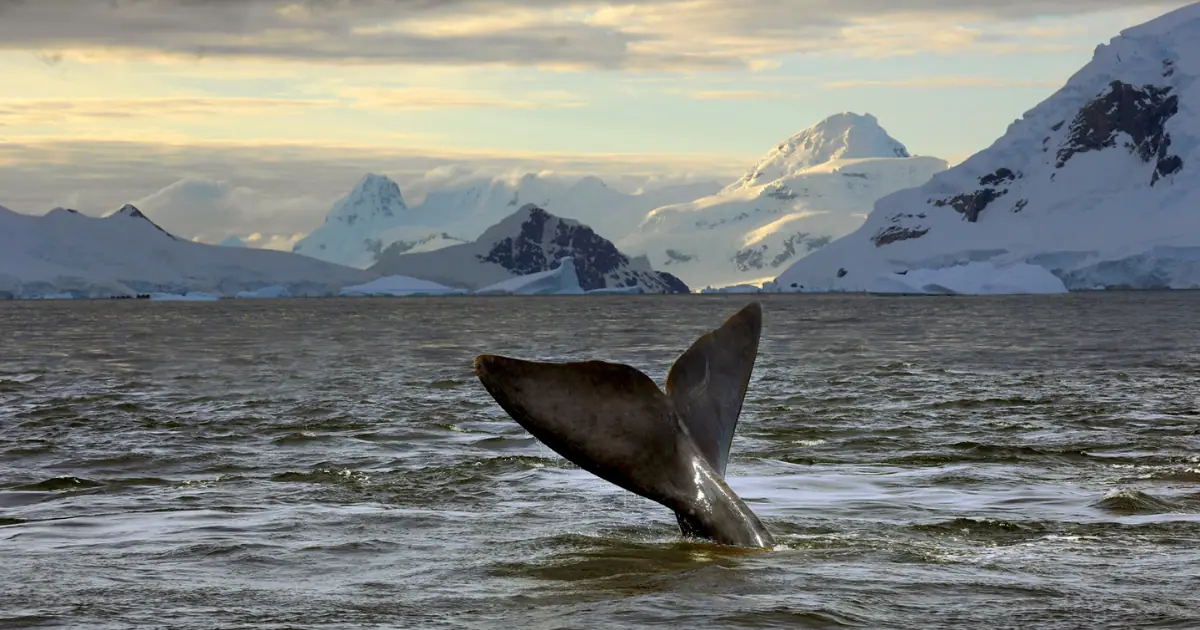
The Antarctic blue whale is the largest subspecies of the largest animal on Earth, and it is one of the hardest whales to see from an expedition ship. Yes, Antarctica has blue whales: they feed in the Southern Ocean through the summer, the same months the cruise ships sail. But estimates put the whole population at between fewer than 2,000 and about 3,000 animals, so a sighting is possible and never something to plan a trip around.
This guide gives you the numbers that exist, says plainly which ones do not, and shows where the best documented sightings come from. If you are choosing dates first, start with our guide to the best time to visit Antarctica and come back once you have a window.
What is the Antarctic blue whale?
The Antarctic blue whale (Balaenoptera musculus intermedia) is the blue whale subspecies of the Southern Ocean, sometimes called the true blue whale. According to the US National Oceanic and Atmospheric Administration (NOAA), consulted in October 2026, it can reach about 110 feet, or 33.5 metres, which makes it longer than the blue whales of the North Atlantic and North Pacific, at about 90 feet. The Australian Antarctic Program says the heaviest blue whale ever weighed was nearly 200 tonnes.
Three more facts explain why seeing one is a matter of luck:
- It eats almost one thing. The Australian Antarctic Program describes the Antarctic blue whale as one of the fussiest feeders in the Southern Ocean, usually taking only Antarctic krill. It can swallow up to 50 tonnes of water and krill in one mouthful and keeps only the krill.
- Nobody knows where it breeds. The same source says the breeding grounds of Southern Hemisphere blue whales are unknown, and thought to lie in deep tropical waters of the Pacific, Atlantic and Indian oceans. Whales feeding in Antarctica are only part of the year’s story.
- It lives a long time. NOAA estimates a lifespan of 80 to 90 years, so a recovery from whaling is measured in decades, not seasons.
How big is an Antarctic blue whale?
The Antarctic and Southern Ocean Coalition gives an average length of 88 feet, about 27 metres, and a record of 98 feet, about 30 metres. The Australian Antarctic Program describes a mottled grey skin that looks pale blue or aqua under water, with a pattern unique to each animal, and NOAA describes a long, slender body with a small dorsal fin. Those two details are what you look for if one surfaces: a very long, pale back and very little fin.
So yes, the Antarctic blue whale is bigger than the blue whales you may have seen elsewhere. The Australian Antarctic Program says the pygmy blue whale grows to about 25 metres and is never found south of 50 degrees south, so the two do not meet in Antarctic waters. A newborn Antarctic blue whale calf weighs about 2.5 tonnes, according to the same source, and late in suckling it can put on 100 kilograms a day. NOAA puts the weight of an adult Antarctic blue whale at more than 330,000 pounds, about 150 tonnes, and says it cruises at about 5 miles per hour (8 km/h) while feeding and travelling, with short bursts above 20 miles per hour (32 km/h).
The South America & Antarctica Wildlife and Ice Calendar
Time your trip to what you most want to see: whales, penguins and glaciers across three countries and Antarctica, month by month, and how their seasons line up when you combine regions in one trip.
How many Antarctic blue whales are left?
Fewer than anyone would like, and the sources do not agree on the number:
| Source | What it says |
|---|---|
| Australian Antarctic Program (page updated December 2024) | Probably fewer than 2,000 |
| WWF UK (article of February 2020) | About 3,000 in 2018 |
| International Whaling Commission (IWC) | Less than 1 percent of the pre whaling population; subspecies listed as Critically Endangered |
The reason is whaling. The IWC says more than 300,000 blue whales were killed in the Southern Hemisphere, nearly 30,000 of them in the 1930 to 1931 season alone. The government of South Georgia, reporting the work of the British Antarctic Survey, puts the number killed in the waters around that island at over 42,000. Hunting blue whales was banned in the mid 1960s, according to the IWC and the Australian Antarctic Program, and in 1994 the IWC created the Southern Ocean Whale Sanctuary over the summer feeding grounds, according to the Antarctic and Southern Ocean Coalition.
The recovery is real but slow. WWF describes the Antarctic blue whale as very slowly recovering from twentieth century whaling.
Where to see blue whales in Antarctica
The best documented place is not the Antarctic Peninsula. It is South Georgia, a sub Antarctic island in the South Atlantic that sat at the centre of the whaling industry. Between 10 and 30 January 2020, a British Antarctic Survey team surveying the island’s waters recorded blue whales on 36 occasions, an estimated 55 animals, mostly off the south coast, according to the South Georgia government. WWF called the count unprecedented after three years of surveys.
Read that number for what it is. It comes from a dedicated research team, with acoustic equipment that detected blue whales very regularly, over about three weeks. It tells you South Georgia is where the whales are coming back. It does not tell you how many a passenger sees from a deck.
| Where | What the records show | What it means for your trip |
|---|---|---|
| South Georgia | 36 sightings and about 55 animals in January 2020, mostly off the south coast | The best documented place. Two of our sailings include it, with three and four days on the island |
| Antarctic Peninsula and South Shetland Islands | We found no published sighting rate from any agency or operator | Treat a blue whale as a bonus, not a reason to book |
| Ross Sea | The Australian Antarctic Program reports blue whales near 78 degrees south, well into the sea ice | Far beyond where Peninsula sailings go |
We will not give you a percentage for the Peninsula, because nobody publishes one. The classic eleven day sailing from Ushuaia spends four of those days on the Peninsula and the South Shetlands, as we set out in our Patagonia and Antarctica itinerary. The rest is the Drake Passage.
When is the best time to see Antarctic blue whales?
Summer, and that is as precise as the evidence allows. Antarctic whales feed in the Southern Ocean when the summer plankton blooms draw krill, according to the Antarctic and Southern Ocean Coalition, and the only dated blue whale survey we found, at South Georgia, ran in January. Ships sail to the Peninsula from late November to March.
No agency publishes blue whale sightings month by month. What we can tell you is when whale watching as a whole peaks: krill reaches its highest levels in February, and our best time to visit Antarctica guide explains why that month suits travellers who care more about whales than penguins. For the temperatures and daylight behind each month, see Antarctica weather month by month.
Which whales will you see instead?
The whales you can count on are different ones. In February, humpbacks, minke whales, fin whales and orcas are frequently encountered on the Peninsula, as the operators we cite in our month by month guide say, and humpbacks are the ones that approach the zodiacs out of curiosity. If whales are the reason you are going, February and March are the months to ask about.
Which of our sailings go to South Georgia?
Two of the Antarctic sailings we sell, both operated by Quark Expeditions, include South Georgia. The 18 day sailing from Ushuaia spends three days on the island, around Grytviken and Shackleton’s grave, and four days on the Antarctic Peninsula. The 23 day sailing adds the Malvinas (Falkland Islands) and four days at South Georgia, and crosses the Antarctic Circle if conditions permit.
Neither promises blue whales, and we will not either. The itineraries mention minke whales on the Zodiac cruises and a lookout for whales at sea. What they give you is time in the one place with a recent record, which a Peninsula only sailing cannot.
How to read your odds before you book
Three questions change them more than anything else:
- Does the itinerary include South Georgia? It is the one place with a documented recent record of blue whales, and a Peninsula only sailing does not go there.
- Which month does it sail? Summer feeding is what puts the whales in the water, so a December to March departure is the right range.
- What does the expedition team record? Ask whether the team keeps sighting logs for blue whales on that route. A team that cannot answer is telling you something.
The Antarctic blue whale in one page
- What it is: the largest blue whale subspecies, about 110 feet at most, feeding almost only on Antarctic krill.
- How many are left: fewer than 2,000 to about 3,000, depending on the source, and under 1 percent of the pre whaling population.
- Where it was recorded: 36 sightings, about 55 animals, off the south coast of South Georgia in January 2020.
- What to expect on the Peninsula: other whales, with a blue whale as a bonus.
- If blue whales matter to you: choose a sailing that includes South Georgia, like our 18 and 23 day itineraries.
If you already have dates in mind, tell us when you travel and what you most want to see, and we will tell you which sailings suit it.

Due to my professional background, I have extensive skills in the identification and characterization of target audiences, which allows me to understand the needs, preferences and specific behaviors of each segment, in order to design effective strategies that contribute to the success of the organization’s communication goals.
I work in the creation of digital content and the design of narratives for companies in the travel and tourism sector, contributing significantly to the promotion of destinations, services and exclusive experiences, generating a positive impact on brand perception.
Throughout my career, I have acquired solid experience in project planning and management, and I am passionate about research and data analysis, especially oriented to the development of user-centric products.
My experience encompasses the development and implementation of sustainable practices in processes, for building solutions that generate positive impact both socially and environmentally.
Always committed to designing effective solutions, I am dedicated to address challenges and contribute to the growth and development of teams and organizations with a holistic and sustainable approach.
0 Comment