



The best time to visit Patagonia is November to March for most trips, because the days are long and the trekking season is running. What most guides leave out is the price of that choice: those are also the windiest months. At El Calafate airport, Argentina’s weather service records strong wind on about 22 days in December, against about 6 days in May.
This guide uses the climate normals of the Servicio Meteorológico Nacional (SMN, 1991 to 2020 for most stations) for El Calafate, Ushuaia, Bariloche and Trelew, the airport station on the Atlantic coast near Puerto Madryn, and turns wind, sun, rain and snow into a choice of month. If you are still deciding how many days each base deserves, start with our guide to how many days you need in Patagonia, or look at the Patagonia tours with Argentina Pura that we plan across both sides of the Andes.
Best time to visit Patagonia by what you want to do
Patagonia runs on three calendars at once: the trekking season around El Calafate and El Chaltén, the cold and wind of Tierra del Fuego, and the wildlife calendar of the Atlantic coast. Find your goal in the table, then check the numbers behind it in the sections that follow. If you are choosing by experience instead of by month, start with our guide to things to do in Patagonia.
| Your goal | Months to look at | What decides it |
|---|---|---|
| Hiking with the least wind | March and April | At El Calafate, wind falls from 23.2 km/h (14 mph) in January to 18.1 km/h (11 mph) in March, and the average high is still 16.6 °C (62 °F). |
| The longest days and warmest highs | December and January | About 16 hours of daylight (our calculation) and highs of 18 to 19 °C (64 to 66 °F), with the strongest wind of the year. |
| The calmest air | June to August | Wind averages 12.7 km/h (8 mph), but highs are 6 °C (43 °F), direct sun is under 4 hours a day and snow falls on 4 to 6 days a month. |
| Southern right whales at Península Valdés | June to October | The window given by Argentina’s national tourism board. |
| Elephant seals at Península Valdés | September to November | The window given by the same board. |
| Orcas at Península Valdés | February to May | The board says the chance of seeing orcas rises in these months. |
| Tierra del Fuego with the least snow | December to March | Ushuaia gets snow on fewer than 2 days a month, but strong wind on 24 to 28 days. |
The table does not show crowds or what closes when, because those change base by base. Our free Patagonia season planner puts temperature, crowd levels and daylight hours for El Calafate and El Chaltén, Ushuaia and Bariloche side by side, month by month.
Patagonia weather by month: wind, sun and snow at El Calafate
El Calafate is the base for the Perito Moreno Glacier and the gateway to El Chaltén, so its record is the most useful single reference for the Argentine side. The SMN publishes this station’s normals for 2001 to 2020, and its wind figures for 2011 to 2020 only. The table shows each month’s average high, average wind, days of strong wind, hours of direct sunshine and days with snow.
| Month | Average high | Average wind | Days of strong wind | Direct sun per day | Days with snow |
|---|---|---|---|---|---|
| January | 19.1 °C (66 °F) | 23.2 km/h (14 mph) | 20.1 | 9.3 hours | 0.0 |
| February | 19.2 °C (67 °F) | 20.6 km/h (13 mph) | 14.3 | 8.6 hours | 0.0 |
| March | 16.6 °C (62 °F) | 18.1 km/h (11 mph) | 14.2 | 6.9 hours | 0.0 |
| April | 12.9 °C (55 °F) | 15.6 km/h (10 mph) | 10.5 | 5.7 hours | 0.4 |
| May | 8.7 °C (48 °F) | 11.8 km/h (7 mph) | 6.3 | 3.8 hours | 1.8 |
| June | 5.5 °C (42 °F) | 12.9 km/h (8 mph) | 7.7 | 3.1 hours | 5.6 |
| July | 5.2 °C (41 °F) | 11.7 km/h (7 mph) | 7.0 | 3.5 hours | 5.9 |
| August | 6.9 °C (44 °F) | 13.6 km/h (8 mph) | 9.7 | 4.8 hours | 4.4 |
| September | 11.1 °C (52 °F) | 16.0 km/h (10 mph) | 11.9 | 6.4 hours | 1.3 |
| October | 13.5 °C (56 °F) | 18.9 km/h (12 mph) | 14.9 | 7.7 hours | 0.9 |
| November | 15.8 °C (60 °F) | 23.9 km/h (15 mph) | 20.1 | 9.2 hours | 0.2 |
| December | 17.9 °C (64 °F) | 24.4 km/h (15 mph) | 21.6 | 8.8 hours | 0.1 |
Patagonia: The Season Planner
Match the month to the trip you want: one chart for El Calafate and El Chaltén, Ushuaia and Bariloche with weather, crowds, what's open and daylight hours, which swing more here than almost anywhere on Earth.
Three things stand out. First, the wind switches on in November: the average jumps from 18.9 km/h (12 mph) in October to 23.9 km/h (15 mph) in November, a rise of about a quarter, and it stays high until January. Second, December is the windiest month on both counts, with 24.4 km/h (15 mph) and 21.6 days of strong wind, more than double July’s average of 11.7 km/h (7 mph). Third, direct sun peaks in January at 9.3 hours a day and falls to 6.9 hours in March.
Two cautions. The SMN counts days of strong wind as its own category, and the normals document does not state the threshold in the sections we read, so use the counts to compare months, not to predict gusts on a trail. The station is also at the airport, and the SMN notes that stations without round the clock observation can record fewer weather events than stations that watch for 24 hours, so treat the counts as a floor.
Patagonia seasons: peak, shoulder and winter in five numbers
Grouping the months the way operators do gives a clearer picture. Our own Patagonia tours page treats November to March as the season when everything is running, March and April and September and October as shoulder months, and June to August as winter. This is what the El Calafate record looks like for each group.
| Season | Months | Average high | Average wind | Days of strong wind per month | Direct sun per day |
|---|---|---|---|---|---|
| Peak | December to February | 18.7 °C (66 °F) | 22.7 km/h (14 mph) | 19 | 8.9 hours |
| Late spring | November | 15.8 °C (60 °F) | 23.9 km/h (15 mph) | 20 | 9.2 hours |
| Autumn shoulder | March and April | 14.8 °C (59 °F) | 16.9 km/h (10 mph) | 12 | 6.3 hours |
| Spring shoulder | September and October | 12.3 °C (54 °F) | 17.4 km/h (11 mph) | 13 | 7.1 hours |
| Winter | June to August | 5.9 °C (43 °F) | 12.7 km/h (8 mph) | 8 | 3.8 hours |
Read November carefully. It is spring on the calendar and part of the main season for operators, but in the wind record it behaves like January. If wind is your main worry, the two shoulder windows give you roughly a quarter less wind than the peak, in exchange for highs that are 4 to 6 °C (7 to 12 °F) lower. September and October bring snow on about one day a month, and March and April on almost none. Days are shorter too: about 12.6 hours of daylight in mid March against 15.9 in mid January, by our calculation.
Best month to visit Patagonia for trekking
For El Chaltén and Torres del Paine, the weather decides how hard the day is, but a booking rule can decide your dates before the weather does. According to the Torres del Paine park’s reservations page, consulted in October 2026, hikers on the W trek and the Paine Massif circuit must reserve accommodation in advance, and without those reservations they cannot enter the mountain area. The rule does not apply to day hikes such as Base Torres or to roadside campsites such as Serrano and Pehoé, and day entry tickets must be bought at least 24 hours before. Our El Chaltén trip planner by nights turns that window into days.
The SMN has no station in El Chaltén or Torres del Paine, so El Calafate is the nearest reference. Read it as a pattern, not a forecast for a ridge. The practical order is to choose the trek, check bed availability in the months the tables above show as calmer, and only then choose among them. If the beds allow it, March gives the best balance in the record: wind 22 percent below January, highs 2.5 °C (4.5 °F) lower and still 6.9 hours of direct sun a day. If you would rather have beds and guides arranged for you, see our guided W circuit with shelters.
Patagonia in winter: calm air, short days
Winter is the one season when wind stops being the main story. El Calafate averages 11.7 km/h (7 mph) in July, about half the December figure, and strong wind falls to 7 days that month. What replaces it is cold and low light: a high of 5.2 °C (41 °F), 3.5 hours of direct sun a day and snow on about 6 days. Ushuaia is darker still, with 1.5 hours of direct sun a day in June and snow on 10.6 days in July.
Whether that is a good trade depends on what you want from the trip. Plan winter around towns and short outings rather than long trail days, and ask your operator which trails and lodges are open in your month. Our guide to Patagonia in June shows what that looks like in practice.
The Perito Moreno Glacier stays open in winter. The national parks administration lists its Los Glaciares sector as open from 9 a.m. to 4 p.m. from May 1 to August 31, against 8 a.m. to 6 p.m. from September 1 to April 30, so a winter visit means an earlier plan and fewer people on the walkways. How long each way of seeing it takes is in our Perito Moreno Glacier guide.
Best time to see wildlife in Patagonia
On the Atlantic coast the animals set the calendar. For Península Valdés, Argentina’s national tourism board gives June to October for southern right whales, September to November for the elephant seal colonies and February to May as the period when orca sightings become more likely. Local operators, including our own Puerto Madryn tours page, quote a longer whale season that runs into December, so treat the board’s window as the safe core and ask which weeks your boat sails. Our guide to Puerto Madryn lines up each animal with its months and the days it needs.
Magellanic penguins follow their own calendar at Punta Tombo. The Chubut provincial government opens the season each September, and the 2024 to 2025 season ran from September to April, so confirm the opening date for your year before you plan around it.
The weather is milder than in the south. At Trelew airport the strong wind count is 5 to 9 days a month from June to October, against 12.5 in January, and the average high climbs from 12.4 °C (54 °F) in July to 21.2 °C (70 °F) in October. If wildlife is the reason for the trip, our whales and penguins trip in Puerto Madryn is built around this coast, and our guide to Patagonia’s animals covers what else you can see.
Ushuaia and Bariloche: where the month matters differently
The chart compares the monthly count of strong wind days at three official stations. El Calafate has a windy season and a calm one, Bariloche sits in between, and Ushuaia never gets a calm month.
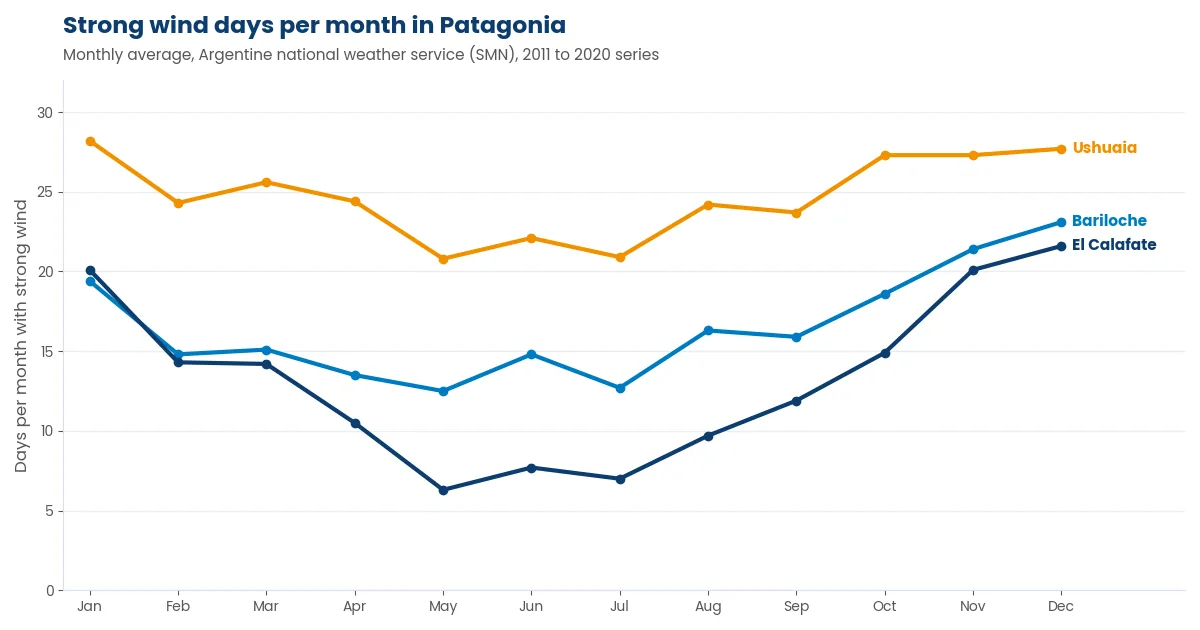
Strong wind days per month, Servicio Meteorológico Nacional (SMN), 2011 to 2020 series. Chart by Argentina Pura.
At the far south the month changes the light and the snow more than the wind. Ushuaia airport records strong wind on 21 to 28 days in every month, so no month is calm. What changes is snow, from 0.2 days in January to 10.6 in July, and direct sun, from 5.3 hours a day in January to 1.5 in June. It also rains or drizzles often all year: 7 to 9 days with at least 1 mm of precipitation in every month.
Bariloche is the base where the month decides the rain. January brings 24 mm of precipitation on 2.5 days, and June brings 168 mm on 13 days, about seven times as much. Strong wind peaks in December at 23.1 days, just as it does in El Calafate.
Putting the five airport stations side by side shows how different the south and the north are. A rainy day is a day with at least 1 mm of precipitation. The SMN sets the period of each station (1991 to 2020 for most, 2001 to 2020 for El Calafate and 1997 to 2020 for Ushuaia), and the wind counts cover 2011 to 2020.
| Station | Warmest month, average high (°C) | July, average high (°C) | Rainy days, January | Rainy days, July | Strong wind days, December | Strong wind days, July |
|---|---|---|---|---|---|---|
| Bariloche | 23 | 7 | 2.5 | 11.6 | 23 | 13 |
| El Calafate | 19 | 5 | 1.4 | 3.0 | 22 | 7 |
| Ushuaia | 14 | 5 | 8.6 | 8.1 | 28 | 21 |
| Trelew | 29 | 12 | 2.2 | 3.2 | 12 | 5 |
| Río Gallegos | 20 | 5 | 5.6 | 4.7 | 27 | 15 |
Two readings follow. El Calafate is dry all year, with fewer than 4 rainy days in its wettest month, so in the south the question is wind and cold, not rain. Trelew, the airport for Puerto Madryn and Península Valdés, is the warm corner of the table, with a January high of 29 °C (85 °F) and a July high of 12 °C (54 °F).
How to choose the best time to go to Patagonia
Start with the thing you cannot move, then let the numbers settle the rest.
- Least wind for hiking: March and April, or September and October if you accept cooler days.
- Longest days and warmest weather: December and January, with wind in the plan.
- Whales: June to October. Elephant seals: September to November. Orcas: February to May.
- Calm air and quiet towns: June to August, with short days and snow.
- Tierra del Fuego without snow: December to March, with wind in every month.
Crowd levels by month for each base, daylight hours and what closes when are in our free Patagonia season planner above. Once you have a window, our guides to Patagonia in October, Patagonia in November, Patagonia in December, Patagonia in March and Patagonia in April go deeper into each month.
To fill that window, our 10 day itinerary with a spare day at each base shows the pacing, and our Patagonia trip cost guide explains how the season changes the price. If you want to add Antarctica, read our guide to combining Patagonia and Antarctica first.
If you already have a month in mind, tell us your dates and who is travelling, and we will tell you which bases fit and what the weather record says for those weeks.

Due to my professional background, I have extensive skills in the identification and characterization of target audiences, which allows me to understand the needs, preferences and specific behaviors of each segment, in order to design effective strategies that contribute to the success of the organization’s communication goals.
I work in the creation of digital content and the design of narratives for companies in the travel and tourism sector, contributing significantly to the promotion of destinations, services and exclusive experiences, generating a positive impact on brand perception.
Throughout my career, I have acquired solid experience in project planning and management, and I am passionate about research and data analysis, especially oriented to the development of user-centric products.
My experience encompasses the development and implementation of sustainable practices in processes, for building solutions that generate positive impact both socially and environmentally.
Always committed to designing effective solutions, I am dedicated to address challenges and contribute to the growth and development of teams and organizations with a holistic and sustainable approach.

0 Comment