



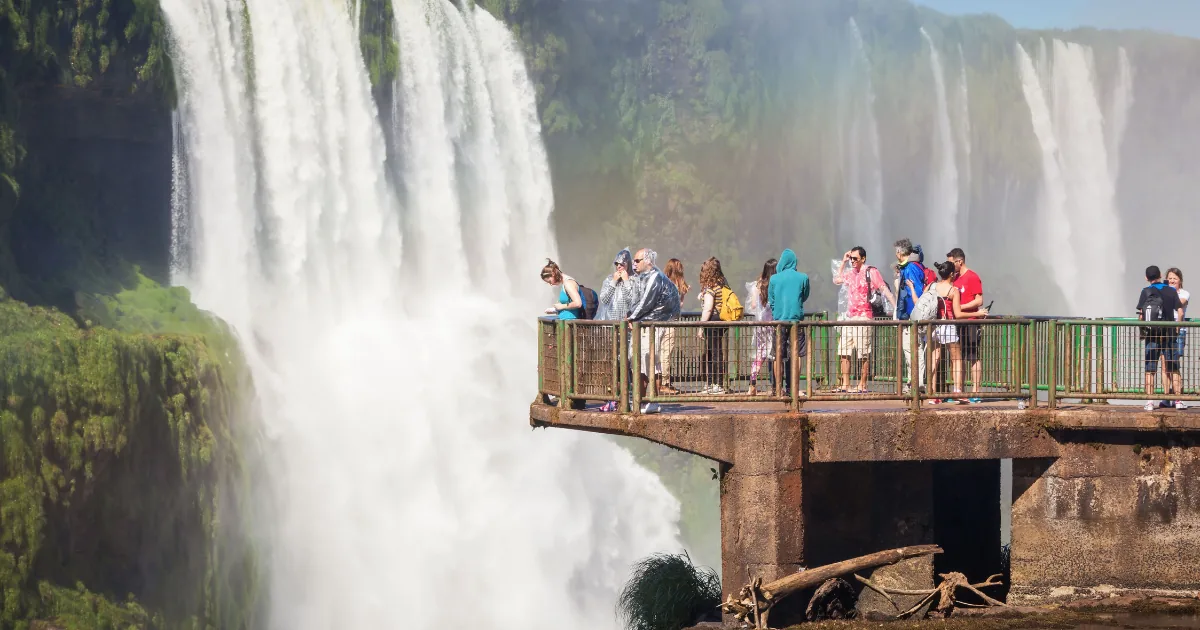
Iguazu Falls Argentina comes down to one national park, three walkable circuits and a river that sets the rules. The park sits 18 km from Puerto Iguazú, the nearest town, according to Argentina’s national parks administration (APN), and a visit depends on three things: how many hours you give the circuits, which circuits are open, and what the river has done in the weeks before you arrive.
This guide gives the verdict first, then the circuits with their lengths, the time each one takes, how the park ticket is built and why the river matters more here than at most waterfalls. For the wider picture, see things to do in Argentina, what each region is worth in days, and for how Iguazú fits a domestic flight route, our 10 day Argentina itinerary.
What makes Iguazu Falls in Argentina worth the trip?
It is worth it if waterfalls are on your list, and it is the part of a first trip that most changes the shape of the route, because Iguazú sits in the far northeast of the country, in Misiones province, on the border with Brazil. Four facts explain why people go:
- The scale. UNESCO describes a semicircular cascade system some 80 m high and 2,700 m in diameter, and inscribed the site on the World Heritage List in 1984.
- The park. APN created Parque Nacional Iguazú in 1934 and says it covers more than 67,000 hectares of the Paranaense rainforest, which is why a visit mixes waterfalls with jungle walkways.
- The recognition. APN lists the falls among the Seven Natural Wonders of the World.
- The walking. The Argentine side is built around walkways that put you above, beside and below the water, and all three circuits are wheelchair accessible in full or in part.
If you only want a photo of the falls, a short stop is enough. If you want to understand why the water is loud from a kilometre away, you need the circuits below.
The Iguazu Falls Argentina side: what each circuit covers
The concessionaire that runs the visitor area, Iguazú Argentina, publishes lengths and walking times for each circuit. The times are for walking, not for queues or train rides.
| Circuit | Length | Walking time | Difficulty | What you see |
|---|---|---|---|---|
| Circuito Superior | 3,700 m round trip | 90 minutes | Low | Panoramic views above the falls, Salto Dos Hermanas, Salto Bossetti, Salto Mbiguá and the Balcón San Martín. 100% wheelchair accessible |
| Circuito Inferior | 2,900 m round trip | 90 minutes | Medium | Salto Lanusse, Salto Álvar Núñez, Salto San Martín from below and views of the Garganta. About 70% wheelchair accessible, with steep stairs on some stretches |
| Garganta del Diablo | 2,200 m round trip | Not given consistently | Low | The main drop, reached by a long walkway from the Garganta station. 100% wheelchair accessible |
Two other paths complete the area: the Sendero Macuco, a jungle trail that closes earlier in the afternoon than the circuits, and the Sendero Verde, the pedestrian alternative to the train. The train, the Tren Ecológico de la Selva, is included in the entry ticket and links three stations: Estación Central, Estación Cataratas and Estación Garganta.
Northern Argentina: The First-Timer's Guide
Avoid the routing mistake most first trips make: how Buenos Aires, Iguazú Falls, Mendoza and Salta really connect, the missing direct flight to plan around, how many days you need and where the road continues into Chile.
Which circuit first?
The choice follows your legs and your day. The Superior circuit is the easier walk, with a low difficulty rating and full wheelchair access, and it stays above the falls. The Inferior circuit takes you closer to the water, rates medium, and has steep stairs in places, with an adapted alternative path for part of the route. If you can only do one, pick by what you want to feel: the Superior for the overview, the Inferior for the spray and the views of the Garganta from below.
If you are travelling with someone who walks slowly or uses a wheelchair, the Superior circuit and the Garganta walkway are the two that the concessionaire describes as fully accessible. Free manual wheelchairs are available at the train stations, and a free golf cart takes visitors with reduced mobility to Estación Central.
Can the river close a circuit at Iguazu Falls?
Yes, because the walkways sit at river level, and the river is the one variable you cannot book. The concessionaire states that its circuits are subject to weather conditions, and that the park stays open in persistent rain although some trails may close temporarily for safety. Its circuit pages show whether each circuit is open and give the reason when one is closed.
Three things follow for any plan, whatever the year:
- Check the status before you book and again the day before. The concessionaire’s circuit pages are the place to look.
- Do not build the trip around a single circuit. The Inferior circuit gives panoramic views of the Garganta, and the Superior circuit reaches the Balcón San Martín, so one closed walkway does not empty the visit.
- Keep a margin day if your dates are fixed. A rising river can close a circuit for a day or longer, and the margin is the only protection that costs nothing.
How much time does the Argentine side need?
Time at Iguazú is set by two numbers: 90 minutes for each of the two main circuits, and the hour at which the circuits close, which is earlier than the park itself.
| Item | Time |
|---|---|
| Circuito Superior | 90 minutes of walking |
| Circuito Inferior | 90 minutes of walking |
| Both circuits | 3 hours of walking, before train rides and queues |
| Garganta del Diablo, when open | 2,200 m round trip, added to the above |
| Sendero Macuco | Extra time, and it closes before the circuits do |
The arithmetic is ours. A circuit takes 90 minutes, so the latest you can start one and finish it before the circuits close is 90 minutes before that closing time, and that moment arrives well before the park gates close. In practice, one full day starting in the morning is the working minimum for both circuits, and a second day makes sense if you want the Macuco trail as well, or a margin against a river closure.
Can you see Iguazu Falls in one day from Buenos Aires?
The park can be seen in a day, but your flights have to fit the circuit hours. A day trip works when you land in the morning and fly out in the evening, with the 3 hours of walking in between. We do not print flight times here, because airlines change them and APN only says to check the frequency for your dates. Our day trip to Iguazú from Buenos Aires is built around that window, and our 2 day trip to Iguazú is the version with a margin.
How much does the Iguazu Falls Argentina ticket cost?
The fixed part of the bill is the park entry, which APN publishes in pesos for Parque Nacional Iguazú and revises by resolution. The table converts the amounts valid from 1 June 2026 at the official rate of the Argentine central bank (BCRA) of 1,517 pesos per dollar on 9 October 2026, so treat the dollar figures as a reference for that date.
| Pass | Pesos | Reference price in USD |
|---|---|---|
| Daily pass, General rate | 60,000 | about USD 40 |
| Second day within 72 hours of the first entry | 30,000 (50% off) | about USD 20 |
| Flexipass, 3 days | 120,000 | about USD 79 |
| Flexipass, 7 days | 210,000 | about USD 138 |
| Annual pass, all national parks | 300,000 | about USD 198 |
APN exempts children from 0 to 6 years inclusive. The structure matters more than the amounts: two days within 72 hours cost 1.5 daily passes, and three separate days cost 2.5 at best, so the 3 day Flexipass, which costs 2 daily passes, saves half a pass if you plan to enter three times. If the peso amounts have been revised by the time you read this, apply the same proportions to the current APN table. Entry is by date and time slot, and APN asks visitors to respect the slot chosen when buying.
The rest of the bill is not fixed. Hotels in Puerto Iguazú, boat rides and transfers change with the season and the operator, so we do not print them.
Iguazu Falls Argentina side or the Brazilian side?
The falls sit on the border, so there are two national parks, one on each side, each run by its own country, and the ticket in this guide covers the Argentine park only. The Argentine side is the one built around walking: three circuits that put you above, beside and below the water, with a free train linking them.
We do not rate one side above the other here, because that depends on what you want from the day, and the Brazilian park needs its own facts, prices and hours. If you are choosing for a particular trip, send us your dates and who is coming and we will say which combination fits.
Before you go
- Rain does not close the park. The concessionaire says it stays open in persistent rain, although some trails can close temporarily for safety.
- Bring water, a cap, sunscreen and comfortable shoes. The concessionaire also recommends insect repellent and a raincoat or poncho for wet days.
- Leave pets at home. They are not allowed in the park, and free kennels beside the car park hold up to six animals.
- Start early. The circuits close before the park does, and a circuit that starts late will not finish on time.
Iguazu Falls Argentina in one page
- Give it a full day. The two main circuits need about 3 hours of walking, plus the train.
- Pick by legs, not by fame. The Superior circuit is the easy one, the Inferior is closer to the water and has stairs.
- Budget the fixed part. The park entry is about USD 40 for one day, and a second day within 72 hours costs half.
- Check each circuit before you book. The river can close one for a day or longer, so keep a spare day if the dates are fixed.
If you already have dates, tell us when you travel and who is coming, and we will check how Iguazú fits your route.

Due to my professional background, I have extensive skills in the identification and characterization of target audiences, which allows me to understand the needs, preferences and specific behaviors of each segment, in order to design effective strategies that contribute to the success of the organization’s communication goals.
I work in the creation of digital content and the design of narratives for companies in the travel and tourism sector, contributing significantly to the promotion of destinations, services and exclusive experiences, generating a positive impact on brand perception.
Throughout my career, I have acquired solid experience in project planning and management, and I am passionate about research and data analysis, especially oriented to the development of user-centric products.
My experience encompasses the development and implementation of sustainable practices in processes, for building solutions that generate positive impact both socially and environmentally.
Always committed to designing effective solutions, I am dedicated to address challenges and contribute to the growth and development of teams and organizations with a holistic and sustainable approach.
0 Comment