



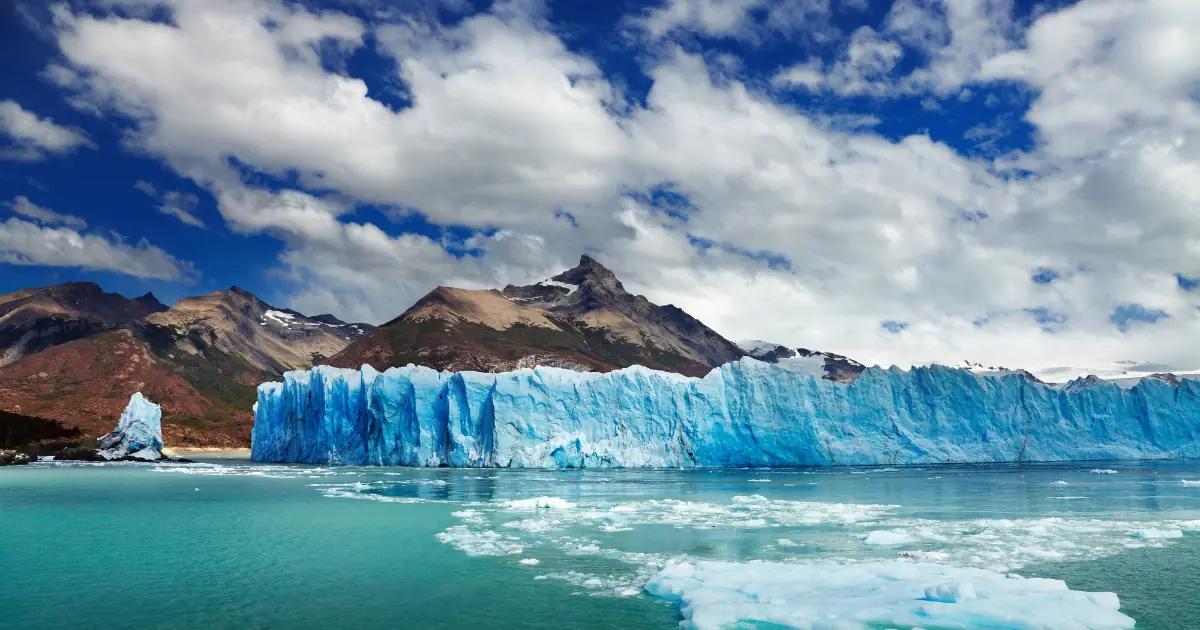
The Perito Moreno Glacier is worth a full day from El Calafate, and the way you visit decides how much of that day you spend facing the ice. The walkways give you 2 to 4 hours in front of the wall, a boat adds about an hour on the lake, and an ice trek turns the outing into 8 to 11 hours once the road is counted. The glacier sits 80 km from town, so the road alone takes about 3 hours round trip.
This guide puts those numbers side by side so you can pick one option before you book anything. Pick your month first with our Meilleure période pour visiter la Patagonie, because the season changes the opening hours and the light. Topics we cover in depth stay in their own guides: how many nights El Calafate needs et où se trouve la Patagonie et à quelle distance se situent les bases les unes des autres.
What is the Perito Moreno Glacier and why is it famous?
It is a glacier of the Southern Patagonian Ice Field that ends in Lago Argentino, inside Los Glaciares National Park. According to Wikipedia, consulted in October 2026, it is about 30 km long, covers 250 square kilometres and has a front 5 km wide. Its height above the water depends on the source: Wikipedia gives an average of 74 m, while the geoheritage page of the International Union of Geological Sciences (IUGS) says the walls reach up to 60 m. We read it as 60 to 74 m, because the two measure different things.
It carries the name of Francisco Moreno, the explorer who studied the region, and the park that holds it was created in 1937 and became a UNESCO World Heritage Site in 1981, according to Argentina’s national parks administration (APN). Three things explain why this glacier, and not one of its neighbours, is the famous one:
- You can reach it. The IUGS names good accessibility and infrastructure among the reasons for its geoheritage status. The tourism board describes wide walkways at different heights, a circuit of several kilometres that people with reduced mobility can use.
- It reaches the water in front of you. The front ends in the lake, so you watch the wall from walkways that face it.
- It misbehaves on a cycle. Periodically the ice pushes across to the Magallanes Peninsula and dams the Brazo Rico arm of the lake. The water rises behind the dam until the ice gives way. Wikipedia and the operator Calafate Tours, both consulted in October 2026, list ruptures in 2004, 2006, 2008, 2012, 2013, 2016, 2018 and 2019, the last one confirmed in December 2019. The gaps are irregular, from a couple of years to more than a decade, and there were 16 years without one between 1988 and 2004.
Sud de l'Argentine : le guide du premier voyage
Construisez votre itinéraire dans le sud argentin dès le départ: ce qu'offrent El Calafate, El Chaltén, Ushuaia, Bariloche et Puerto Madryn, à qui chaque étape convient, comment elles se comparent en climat et en effort, et les erreurs classiques pour les combiner.
One caution on the current state. For decades the front barely moved, and the IUGS page still describes it as stable. Newer sources say that has changed: Wikipedia reports a retreat on the northern front since 2020, and Earth.com, in March 2026, describes an accelerated retreat since 2020 based on a study in the journal Communications Earth and Environment. Do not plan a trip around a promise that the glacier is stable or advancing, and expect the wall to look different from older photos.
Where is the Perito Moreno Glacier and how do you get there?
The glacier is 80 km from El Calafate by Provincial Route 11, about 1 hour 30 minutes by car, according to APN and the national tourism board, both consulted in October 2026. Buses and organised tours leave from town, and a rental car works because the road is the only way in. Confirm the return time before you book, since it sets how long you stay.
The corridor to the glacier has opening hours, and they change with the season. APN publishes access from 8:00 to 18:00 between 1 September and 30 April, with visitors allowed to stay until 20:00. Between 1 May and 31 August the access is from 9:00 to 16:00, with visitors allowed to stay until 18:00. The park entry fee is covered, with the arithmetic, in our El Calafate guide.
The road needs patience. APN, as reported by Winfo Santa Cruz in March 2025, sets a speed limit of 40 km/h on the 30 km stretch inside the park, which has many curves, so a rental car does not save as much time as the distance suggests. The same communication says park tickets are named to one person and cannot be transferred or moved to another date after purchase. That rule may have changed, so confirm it when you buy, and buy for the day you are sure of.
A day that leaves town at 7:30 reaches the walkways around 9:00 in either season. In summer that leaves you most of the day at the glacier, and in winter the 16:00 last entry limits you more than the road does.
How long do you need at the Perito Moreno Glacier?
It depends on the option, and the table is the answer. The times come from the operator guides we consulted in October 2026 and from the tourism board, and the last column is our arithmetic, adding the 3 hours of road. Operations validates these figures for each season.
| How you visit | Time at the glacier | Door to door from El Calafate |
|---|---|---|
| Walkways only | 2 to 4 hours | 5 to 7 hours |
| Walkways plus a boat | Add about 1 to 1.5 hours | 6 to 8 hours |
| Minitrekking | About 5 hours, with 1.5 to 2 hours on the ice | About 8 hours |
| Big Ice | 6 to 8 hours, with about 4 hours on the ice | 9 to 11 hours |
Three notes on the table:
- The walkways run longer than you plan. A full circuit of all the levels takes about 2 hours, and one operator guide puts a visit that includes watching and photographing the ice at 3 to 4 hours.
- Access is not the same on every level. The tourism board calls the circuit accessible for reduced mobility, while one operator guide notes many stairs and a single adapted trail. If anyone in your group walks with difficulty, ask which trail is adapted before you choose the day.
- The boat is short. Operators describe the lake outing as 1 hour to 1 hour 30 minutes, and the Brazo Rico boat tour listed by the tourism board lasts about 1 hour. It gets you closer to the foot of the wall, and the walkways give you the height.
- Ice treks follow the operator. The tourism board counts 6 to 8 hours in total once transfers and preparation are included. Operators set age and fitness limits that change by season, so confirm them when you choose between minitrekking and Big Ice.
Is the Perito Moreno Glacier worth it?
Yes for almost every trip that passes through El Calafate, and the real question is which option. This table matches the option to the traveller.
| If you are | Choose | Pourquoi |
|---|---|---|
| Here for one day and want the classic view | Walkways plus a boat | The two together show the wall from above and from the lake |
| Travelling with someone who walks slowly | Walkways only | The tourism board describes the circuit as accessible for reduced mobility |
| Comfortable on uneven ground and want to stand on the ice | Minitrekking | It puts about 1.5 to 2 hours on the ice inside a day |
| Fit, and want the ice to be the whole day | Big Ice | About 4 hours on the ice, and the longest day of the four |
| Short of days in town | Walkways only | It is the only option that fits a flight day |
The honest limit is time. If you have a single day in El Calafate, the walkways with a boat use it fully, and the ice trek is better placed on a second day. Our 5 day itinerary for El Calafate and El Chaltén shows where the glacier day sits in a route.
Can you plan around the ice falling?
Not precisely. Ice breaks from the wall in pieces through the day, and large falls and the lake rupture have no schedule. What you can control is the time you give it. If watching the ice is why you came, allow at least 3 hours at the walkways rather than the 2 hours the circuit needs, because the circuit shows you the wall and the waiting shows you the falls.
A longer stay is also more forgiving. Our recommendation, not an official figure, is to leave one buffer hour in the afternoon, so a cloudy spell or a queue for the boat does not cost you the best view of the day.
For the season, the tourism board lists spring and summer, from September to March, as the best period, and the glacier corridor has the longest hours then. For wind, sun and snow month by month, use the best time guide linked at the top.
Perito Moreno Glacier in one page
- Count the road. The glacier is 80 km away, so add about 3 hours to every option.
- Pick one option. Walkways take 2 to 4 hours, a boat adds about an hour, minitrekking and Big Ice fill the day.
- Regarde l'heure. Summer access runs 8:00 to 18:00 and winter access 9:00 to 16:00, with visitors allowed to stay later.
- Give the ice time. The falls cannot be scheduled, so allow at least 3 hours at the walkways.
Si vous avez déjà des dates, dites-nous quand vous partez et qui vous accompagne, and we will check which way of visiting fits your days.

Grâce à mon parcours professionnel, je dispose de compétences étendues en matière d'identification et de caractérisation des publics cibles, ce qui me permet de comprendre les besoins, les préférences et les comportements spécifiques de chaque segment, afin de concevoir des stratégies efficaces qui contribuent à la réussite des objectifs de communication de l'organisation.
Je travaille à la création de contenus numériques et à la conception de récits pour des entreprises du secteur du voyage et du tourisme, contribuant de manière significative à la promotion de destinations, de services et d'expériences exclusives, générant un impact positif sur la perception de la marque.
Tout au long de ma carrière, j'ai acquis une solide expérience en matière de planification et de gestion de projets, et je suis passionnée par la recherche et l'analyse de données, notamment en ce qui concerne le développement de produits centrés sur l'utilisateur.
Mon expérience englobe le développement et la mise en œuvre de pratiques durables dans les processus, pour construire des solutions qui génèrent un impact positif à la fois sur le plan social et sur le plan environnemental.
Toujours soucieuse de concevoir des solutions efficaces, je m'attache à relever les défis et à contribuer à la croissance et au développement des équipes et des organisations par une approche holistique et durable.

0 Commentaire