



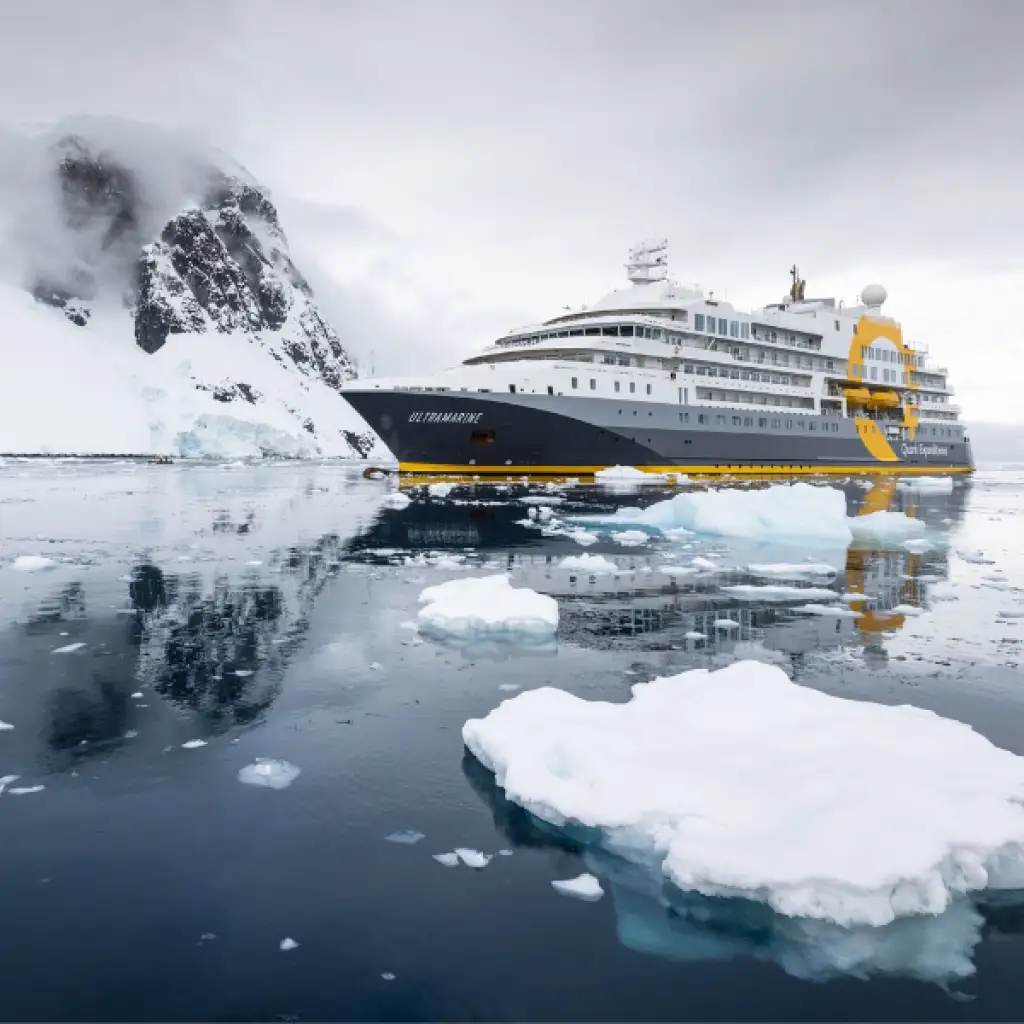

Every other trip in South America can move. You can shift a glacier day, swap two nights, take the later flight. An Antarctic sailing cannot: it leaves on a stated afternoon from a stated port, and if you are not on it, you have missed it.
That single fact decides the shape of the whole trip. A Patagonia and Antarctica itinerary is not two holidays booked next to each other. It is one fixed date with a land trip built backwards from it, and the questions that matter are which port, how many days the crossing eats, and how much margin sits between the two halves.
The sailing date is the only fixed point in the trip
Look at how our classic sailing is structured. Day one you arrive in Ushuaia. Day two you embark, in the late afternoon. There is one night of margin between landing at the southernmost airport in the country and the gangway going up.
One night is what the cruise itself provides, and it is not what we would plan on. Flights into Ushuaia come through Aeroparque in Buenos Aires, which is the hub almost the entire domestic network runs through, as our guide to ten days across Argentina sets out. A cancellation there on the wrong morning does not cost you a hotel night. It costs you the sailing.
So the rule we work to is simple: the land half goes before the cruise rather than after it, and it ends in the port city with time to spare. Two nights in the port before embarkation is the version we build. It looks like an indulgence on a spreadsheet and it is the cheapest insurance in the itinerary.
Four of the eleven days are the Drake Passage
This is the number that reframes the whole decision, and it is rarely printed next to the brochure photograph.
The classic eleven-day sailing from Ushuaia breaks down like this: one day arriving, one day embarking, two days crossing the Drake Passage, four days in the South Shetlands and on the Antarctic Peninsula, two days crossing the Drake again, and one morning disembarking. Four days at sea in transit. Four days actually in Antarctica.
The crossing is about 500 nautical miles and takes roughly 48 hours each way, sometimes as little as 36 in good conditions and longer into a headwind. Whether those days read as a rest or as an ordeal depends on weather you cannot book. Some people find the two days at sea the most restful part of the trip, with lectures, seabirds behind the ship, and nothing to do. Others spend them horizontal.
Both reactions are common enough that the industry sells a way out of it.
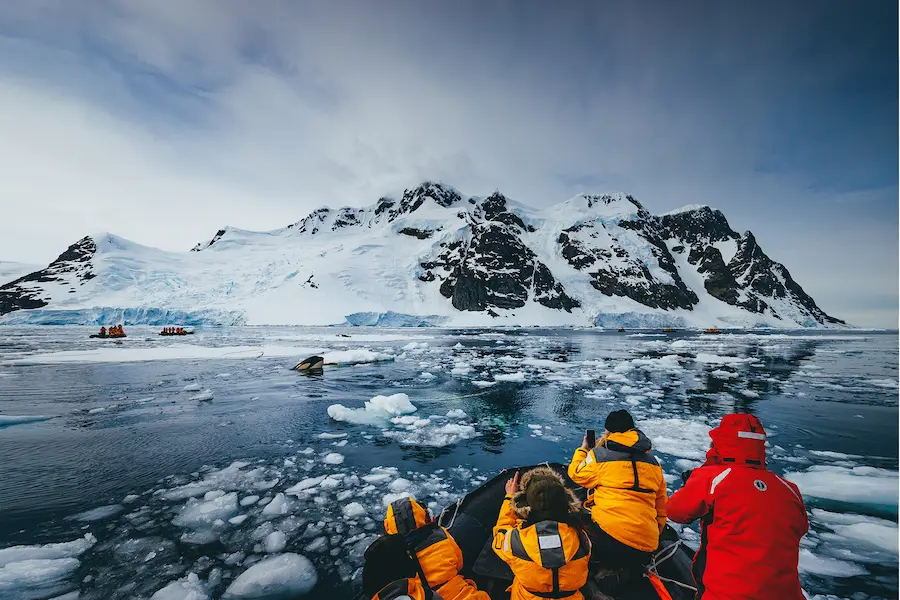
As for whether four days on the Peninsula is enough, it is more time than the number suggests. Landings run twice a day when the weather allows, by zodiac, and the days are long enough in the southern summer that light is rarely the constraint. What varies is how many of the eight planned landings the sea lets you make, which is why the operators do not publish a fixed itinerary for that stretch.
Flying the Drake buys back four days, and here is the price of them
There is a version that skips the crossing entirely: you fly from southern Chile to King George Island, about two hours each way, and join the ship there.
| Route | Tage | Days at sea crossing | Days in Antarctica | Von |
|---|---|---|---|---|
| Antarctic Explorer, sailing from Ushuaia | 11 | Four | Four | 7.420 € |
| The same, starting in Buenos Aires | 12 | Four | Five | 7.420 € |
| Antarctic Express, flying the Drake | 8 | Keine | Four | 11.966 € |
Read the first and third rows together. You get the same four days in Antarctica, you save four days of your life, and it costs about sixty per cent more. That is the trade, stated plainly, and it is a personal decision rather than a right answer. Our Antarctica cruise page has the full range, including the longer sailings that reach the Antarctic Circle and South Georgia.
The middle row is worth a second look. The twelve-day version starts in Buenos Aires with the domestic flight to Ushuaia included, and it carries the same starting price as the eleven-day version that starts in Ushuaia. If you were going to fly down from Buenos Aires anyway, and you were, that day is close to free and it removes the single riskiest connection in the trip from your own hands.

What to do with the two nights before you sail
The buffer nights are not dead time, which is the part that makes them easy to justify.
Ushuaia has two half days that fit neatly into a pre-embarkation window. The Nationalpark Tierra del Fuego visit runs about five hours, of which two and a half to three are walking, on a circular route past Laguna Verde, the Rio Ovando, and Lapataia Bay, with roughly three and a half kilometres of flat coastal ground. The Beagle Channel navigation is a morning on sheltered water past the sea lion and cormorant colonies and the lighthouse at Les Eclaireurs, with seating inside and a deck when you want it.
That second one is worth doing before the Drake rather than after, for a reason that is not obvious: it is a gentle way to find out how you feel on a boat, on water that stays flat, while you still have a day to buy seasickness medication. Our Ushuaia trips page has both with their durations.
If you sail from Punta Arenas instead, the equivalent buffer sits on the Chilean side and the natural filler is a day in Torres del Paine or the Milodon Cave, which our fourteen-day route covers.
Which port you sail from decides where the Patagonia half ends
Here is where the two halves actually touch, and where most combined itineraries are put together backwards.
Ein Boot im Hafen von Ushuaia, dem Tor zur Antarktis Ushuaia. That means the Patagonia half should run north to south and finish in Tierra del Fuego: El Calafate, El Chalten if you have the days, then Ushuaia, then the ship. Our ten-day Patagonia route already ends in Ushuaia, which makes it the natural land half for a sailing.
If you fly the Drake, you leave from Punta Arenas, in Chile. That is a completely different exit, and it changes which Patagonia route makes sense: the one that crosses the border and finishes on the Chilean side. Our fourteen-day route across both sides of the Andes ends at Punta Arenas already, for reasons that had nothing to do with Antarctica and turn out to line up exactly.
Pick the sailing first, then pick the land route that ends at the right airport. Doing it the other way round produces the itinerary that flies from El Calafate to Ushuaia, then back up to Buenos Aires, then down to Punta Arenas, which is three flights to solve a problem that one decision would have avoided.

The two seasons overlap, which is the one easy part of this trip
Antarctica sails from November to March, when the ice breaks up. Patagonia’s season is the same November to March window, with October and April as workable shoulders in the south.
That overlap is genuine luck, and it means the question is not whether the halves fit but which part of the window you want.
- November. Deep snow, the most ice, penguins courting and building nests, around twenty hours of daylight. Few whales, because they are still moving south. In Patagonia it is spring, quieter trails, and less settled weather.
- December and January. Peak. Chicks hatching from mid-December, close to twenty-four hours of daylight, snow receding from the landing sites, whales arriving in numbers. Also the busiest and dearest month in Patagonia.
- February and March. Chicks fledging, adults moulting, and the strongest whale watching of the season, with humpbacks that approach the zodiacs out of curiosity. Daylight drops from about sixteen hours to about thirteen, which brings back sunsets and the light photographers want. In Patagonia, March is one of the finest months of the year.
If we had to pick one part of the window for a combined trip rather than for either half alone, it would be late February into March: the whales are at their best, the Patagonian trails have emptied, and the light is on your side in both places.
How a Patagonia and Antarctica itinerary is built backwards
The order of decisions matters more than the content of them, so this is the sequence we work in.
- Fix the sailing. Date, ship, and port. Everything else is downstream and nothing else is immovable.
- Choose the land route that ends at that port. Ushuaia for a sailing, Punta Arenas if you fly the Drake.
- Put two nights in the port city before embarkation. One is what the cruise gives you. Two is what the domestic flight network deserves.
- Count the land days backwards from there, and be honest that a fortnight of Patagonia plus eleven days of Antarctica is a month away from home.
- Leave the return open at the end. Ships come back late, weather delays disembarkation, and a same-day long-haul connection out of Ushuaia is the one piece of this trip we would not build.
Point four is the one people underestimate. The combination is not a long holiday, it is two trips. If the total has to be shorter, the honest lever is the land half: five days around El Calafate and El Chalten, described in our five-day Patagonia route, still gives you the glacier and Fitz Roy before you sail.
What the two halves cost together, and what sits outside
The sailing is the large number and it is the one to settle first, because it does not move and the land half does.
Taking the classic eleven days from 7.420 € and a ten-day Patagonia route from around 1.674 €, the combination sits near nine thousand euros a head before flights, for roughly three weeks. Flying the Drake instead of sailing it adds about four and a half thousand and gives you four days back.
What sits outside both halves is worth listing, because it is a meaningful sum on a trip of this length: the international flights, the domestic flight into the port city if you book the Ushuaia departure rather than the Buenos Aires one, meals beyond breakfast on the land half, and the national park entries, which foreigners pay at a separate rate and in cash. Our guide to what a trip to Argentina costs goes through those, and what a Patagonia trip costs stellt Argentinien in einen Zusammenhang. comparison of what each South American country costs puts Argentina in context.
Tell us which sailing you are looking at and we will build the land half around it, in the right direction and with the margin in the right place. Our Antarctica cruise page lists the departures, and our Patagonien-Touren page has the routes that end where the ships leave from.

Ich begann meine berufliche Laufbahn in der Welt des Reisens im Jahr 2003, als ich mein Studium an der Esuela La Suisse in Buenos Aires abschloss, aber meine Leidenschaft für das Reisen stammt aus meiner Kindheit, als ich nach und nach meinen Abenteuergeist und meine Liebe zur Natur entwickelte.
Ich habe verschiedene Reiseunternehmen durchlaufen, bevor ich 2008 mein eigenes gegründet habe. Dabei habe ich viel über Reisende und die Erwartungen der verschiedenen Profile gelernt und Argentinien und die Region wie meine Westentasche kennengelernt.
Mit der Gründung von Argentina Pura ist es mein größter Wunsch, mit den Träumen anderer Menschen zusammenzuarbeiten und meinen Beitrag zur Umwandlung des Tourismus in eine wirklich nachhaltige Aktivität zu leisten, die mit der Entwicklung der einheimischen Gemeinden zusammenarbeitet und gleichzeitig deren wirtschaftliches Wachstum fördert.
Argentina Pura ist die Kombination aus Kreativität, Verantwortungsbewusstsein und Reife in meiner Welt des Reisens.

0 Kommentar